Summary:
You set up the tank, let it run for a few days, added fish — and then things went sideways. Maybe the water clouded up. Maybe a fish died. Maybe you’ve been battling green fuzz on every surface for weeks and nothing seems to fix it. If any of that sounds familiar, you’re not alone, and you’re not doing something obviously wrong. What most people are never told at the point of purchase is that a brand-new aquarium is biologically uninhabitable for weeks. The nitrogen cycle is the reason — and once you understand it, almost everything else about your tank starts to make sense.
What Is the Fish Tank Nitrogen Cycle?
The nitrogen cycle is the biological process that makes an aquarium safe for fish and invertebrates. It’s not a feature you turn on — it’s something that has to develop naturally over time, driven by colonies of beneficial bacteria that your tank doesn’t have on day one.
Here’s the short version: fish waste, uneaten food, and decaying organic matter all produce ammonia. Ammonia is toxic. Left unchecked, it can reach lethal concentrations within hours of adding fish to a new tank. The nitrogen cycle is the process by which bacteria convert that ammonia into less harmful compounds — first into nitrite, which is also toxic, and then into nitrate, which is far less immediately dangerous and manageable through regular water changes.
A tank is considered fully cycled when ammonia reads 0 ppm, nitrite reads 0 ppm, and nitrate is detectable. Until that point, your tank is in a vulnerable biological state — and that’s the window where most new hobbyists lose fish without ever understanding why.
How Long Does It Take to Cycle a Tank with Fish?
The honest answer is longer than most people expect. A full nitrogen cycle typically takes anywhere from four to eight weeks, and that timeline doesn’t compress just because you’re impatient or because the water looks fine. The first four to six weeks are often called “new tank syndrome” — a period where ammonia and nitrite spike to dangerous levels before the bacterial colonies are large enough to process them efficiently.
Fish-in cycling, where you add hardy fish to a new tank to produce the ammonia that feeds the bacteria, is one of the oldest methods in the hobby. For freshwater tanks, zebra danios are commonly used because of their resilience. For saltwater, some hobbyists have used damselfish for the same reason. The risk is real, though — you’re deliberately exposing livestock to elevated toxins, which means close monitoring and frequent water changes are non-negotiable throughout the process.
A more controlled approach is fishless cycling, where you dose the tank with pure ammonia — typically ammonium chloride — to feed the bacteria without putting any animals at risk. This gives you more control over the process and generally produces a more robust bacterial colony before fish are ever introduced. Bacterial supplements like Fritz Turbo Start or Dr. Tim’s One and Only are legitimate tools that can meaningfully accelerate this process when used correctly — they’re not a shortcut, but they do give the cycle a head start.
The most important thing to understand here is that water clarity tells you nothing about where you are in the cycle. A tank can be crystal clear and lethally high in ammonia. A test kit is the only way to know where you actually stand — and testing regularly throughout the cycle is not optional, it’s the whole game.
Cycling a Saltwater Aquarium Is Different — Here's Why
Most of the cycling content you’ll find online is written with freshwater tanks in mind. The biology is the same at its core, but saltwater and reef tanks introduce variables that change the timeline, the method, and the margin for error considerably.
Live rock is the most significant difference. Porous live rock hosts enormous colonies of nitrifying bacteria and has traditionally been the backbone of reef cycling. A tank seeded with quality live rock is essentially importing an established bacterial community — which can dramatically shorten the cycling window compared to starting from scratch with dry rock. That said, live rock also comes with hitchhikers, and not all of them are welcome.
Salinity itself affects how quickly bacteria colonize. The specific gravity of your water, typically maintained between 1.024 and 1.026 for reef tanks, influences bacterial growth rates in ways that freshwater cycling doesn’t have to account for. Temperature stability matters more too — reef systems run warmer, and swings in either direction slow bacterial activity.
The bigger issue with reef cycling is the sensitivity of the animals you’re working toward housing. Coral is far less forgiving of ammonia spikes than most fish. Even trace amounts of ammonia can stress or bleach coral tissue. This means that for a reef tank, “close enough” on the cycle isn’t actually close enough — you need ammonia and nitrite at a confirmed, sustained zero before any coral goes in. We’ve seen tanks where hobbyists added coral at week four because the numbers looked okay, only to watch a slow, invisible ammonia creep do damage over the following weeks. The cycle has to be genuinely complete, not just trending in the right direction.
The Aquarium Cycle Doesn't End When the Numbers Hit Zero
Here’s something the beginner guides don’t usually tell you: completing the nitrogen cycle is the beginning of water chemistry management, not the end of it. Once your ammonia and nitrite are at zero and nitrate is detectable, you’ve established the foundation — but the tank is now a living system that requires ongoing attention to stay in balance.
Nitrate accumulates over time and must be exported through water changes, live plants, or in reef systems, a refugium or macroalgae section. As you add more livestock, increase feeding, or change equipment, the bacterial load shifts. Parameters that were stable at week eight can drift by week twelve if nothing changes about your maintenance routine.
This is the phase where most hobbyists start running into the problems they didn’t anticipate when they were focused on cycling — and the most common one is algae.
If you’ve ever scrubbed green fuzz off your glass and rocks only to watch it come back within days, you already know that cleaning doesn’t fix hair algae. That’s because hair algae isn’t a cleaning problem — it’s a chemistry problem. Specifically, it’s a symptom of elevated nutrients: nitrates and phosphates that have accumulated to the point where algae can outcompete everything else in the tank.
Green hair algae in saltwater tanks is one of the most common frustrations in the hobby, and it almost always traces back to a nitrogen cycle that was rushed, or a maintenance routine that let nutrients creep upward over time. Scrubbing it without addressing the underlying chemistry is like mopping the floor while the faucet is still running. The algae will be back, and it will be back quickly.
For reef tanks, there’s a more stubborn variant worth knowing about: Bryopsis. It looks similar to hair algae but has a fern-like, feathery structure and is notoriously difficult to eradicate. Bryopsis is often linked to magnesium imbalances — reef tanks should maintain magnesium between 1,250 and 1,350 ppm, and when levels drop, Bryopsis tends to take hold. Reef Flux, which contains fluconazole, is a commonly used treatment that specifically targets Bryopsis and is considered reef-safe when dosed correctly. It’s one of the few chemical interventions that actually works on this particular algae, and many hobbyists who suffer through months of manual removal don’t realize it’s an option.
Red hair algae in reef tanks and white hair algae are less common but follow the same logic — they’re nutrient indicators, not random occurrences. Before reaching for any treatment, the first step is always a thorough water test to understand what the parameters are actually doing.
Standard hobby test kits cover the essentials — ammonia, nitrite, nitrate, pH, alkalinity, calcium, magnesium, phosphate, and salinity. For most freshwater tanks and newer reef setups, that’s sufficient. But for established reef systems, especially those experiencing unexplained coral stress, persistent algae problems, or parameter instability, a basic test kit often can’t tell you what’s actually wrong.
ICP testing — Inductively Coupled Plasma testing — is the gold standard for comprehensive reef water analysis. It detects trace elements, heavy metals, and ionic imbalances at a level of precision that no hobby kit can approach. Things like elevated copper from old plumbing, iodine imbalances, strontium levels, or silicate contamination from tap water all show up on an ICP panel and can be invisible to every other test you run. If you’re doing everything right and your reef still isn’t thriving, an ICP test is often where the answer finally appears.
Speaking of tap water — this is worth addressing specifically for Nassau County, NY. Municipal water in Nassau County contains chloramine, not just chlorine. Chloramine is more persistent than chlorine and cannot be removed by simple aeration or standard dechlorinators alone. It requires either a sodium thiosulfate product that also neutralizes ammonia, or ideally a dedicated RO/DI (reverse osmosis/deionization) system. Using untreated Nassau County tap water to fill or top off a tank introduces chloramine directly into the system, which can stall or damage the nitrogen cycle and harm livestock. This is a detail that matters locally and that most generic cycling guides will never mention.
When the Nitrogen Cycle Keeps Defeating You, It Might Be Time for a Different Approach
The nitrogen cycle isn’t complicated once you understand it — but managing it well, especially in a reef system, takes time, consistency, and the kind of pattern recognition that only comes from having seen a lot of tanks. Knowing the biology is one thing. Knowing what a struggling cycle looks like at week three versus week six, or recognizing that your Nassau County, NY tap water is quietly undermining your parameters, is something else entirely.
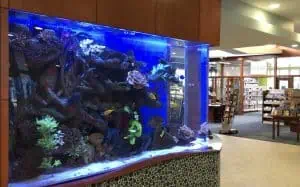
We’ve been setting up and maintaining aquariums on Long Island since 2003. In that time, we’ve cycled tanks from scratch, rehabilitated tanks that crashed, and installed systems as complex as the Bioscience Aquarium Lab at Farmingdale State College right here in Nassau County. Every tank we touch gets a dedicated aquarist who knows its history — not a rotating crew.
If you’ve been fighting your tank and not winning, or if you’re starting fresh and want to do it right the first time, Island Fish & Reef is here to help.
—
**Does clear water mean my aquarium cycle is complete?**
No — and this is one of the most common misconceptions in the hobby. Water clarity has nothing to do with where you are in the nitrogen cycle. A tank can be crystal clear while ammonia is at levels that will kill fish within hours. The only way to know your cycle status is to test for ammonia, nitrite, and nitrate with a reliable test kit. For Nassau County, NY residents using municipal tap water, we also recommend testing for phosphate and verifying that chloramine has been properly neutralized before any readings mean what you think they mean.
**What’s the best reef tank test kit for a beginner?**
For a beginner reef tank, a quality liquid test kit that covers ammonia, nitrite, nitrate, pH, alkalinity, calcium, magnesium, and phosphate will handle most situations. API and Salifert are widely used and reasonably accurate for hobby purposes. Once your tank is established and you’re keeping coral, an ICP test is worth running periodically — it catches trace element and heavy metal issues that no standard kit will detect. If you’re in Nassau County and using tap water, make sure your kit includes a phosphate test, since chloramine-treated municipal water can introduce compounds that affect nutrient levels in ways that catch new hobbyists off guard.
**How much does aquarium service cost?**
There’s no single answer because it depends on the size of your tank, the type of system (freshwater, saltwater, or reef), the frequency of service visits, and what the tank actually needs. We offer competitive pricing and contracting plans for Nassau County customers — the best way to get an accurate picture is to reach out directly so we can assess your specific setup and give you a real number rather than a guess.