
Summary:
Your tank looks great. The water is clear, the filter is running, and you’ve been waiting a day or two just like the pet store suggested. So why are your fish acting strange — or worse, why did they die?
The answer, almost every time, is the nitrogen cycle. It’s invisible, it takes weeks, and no one at the big-box store is going to walk you through it at the register. But once you understand what’s actually happening in your tank’s water, a lot of things start to make sense.
This guide covers the whole process — what it is, how long it takes, and what Nassau County hobbyists specifically need to know before they add livestock.
What Is the Fish Tank Nitrogen Cycle?
Every aquarium produces waste. Fish excrete ammonia directly through their gills and in their urine. Uneaten food breaks down. Organic matter decays. Left unchecked, ammonia accumulates in the water column and becomes lethal — fish gills are essentially bathing in it constantly.
The nitrogen cycle is the biological process that converts that ammonia into less harmful compounds, driven entirely by colonies of beneficial bacteria that establish themselves in your filter media and substrate. Without those bacteria, there is no safe aquarium. With them, the tank becomes a self-regulating ecosystem that can sustain fish long-term.
The process moves in three stages: ammonia is converted to nitrite by one bacterial species, then nitrite is converted to nitrate by another. Nitrate is far less toxic and is managed through regular water changes. That’s the whole cycle — but the critical detail is that those bacteria take weeks to grow.
The Ammonia-to-Nitrate Chain Explained
Here’s how it actually unfolds. When you first set up a tank, there are no beneficial bacteria present. Ammonia begins to accumulate almost immediately — even before you add fish, if you’re using tap water or any organic material.
Once ammonia reaches a certain concentration, a bacterial species called Nitrosomonas begins to colonize your filter media. These bacteria consume ammonia and produce nitrite as a byproduct.
Nitrite is not an improvement. It’s actually toxic to fish in its own right, blocking their ability to carry oxygen in the bloodstream. As nitrite rises, a second bacterial species — Nitrospira — begins to establish itself. Nitrospira converts nitrite into nitrate, which is relatively harmless at low concentrations and removed through water changes.
The cycle is considered complete when ammonia reads zero, nitrite reads zero, and nitrate is detectable and stable. That combination tells you both bacterial colonies are established and functioning. Ammonia should be under 0.06 ppm in the first two weeks, nitrites should stay below 0.75 ppm through the middle weeks, and by weeks five or six you should see nitrates approaching 25 ppm as ammonia and nitrite both crash toward zero.
The reason this takes so long is simple biology. Nitrifying bacteria double in population only every fifteen hours under ideal conditions. That’s extraordinarily slow compared to most microorganisms, which is exactly why you can’t rush this process with extra water changes or wishful thinking. Under normal conditions, plan on four to eight weeks. With seeded filter media from an established tank or quality bottled bacteria products, you can sometimes compress that to one to two weeks — but the cycle still needs to happen.
Ammonia is colorless and odorless. Your tank can look absolutely pristine and still be at levels that are acutely toxic to fish. If your test kit can measure any ammonia at all, the fish are already under stress. Clear water is not a clean bill of health.
Cycle a Tank With Fish Already in It — What to Do
A lot of hobbyists end up in this situation. They added fish before they knew about cycling — maybe the pet store told them 24 hours was enough, or they inherited a tank and didn’t realize the cycle had never been established. Now they’re watching fish show signs of stress and trying to figure out what to do without losing everything.
Fish-in cycling is harder to manage than fishless cycling, but it’s not impossible. The goal is to keep ammonia and nitrite low enough that fish survive while the bacterial colonies have time to grow. That means testing your water every single day — not every few days, every day — and doing small, frequent water changes whenever ammonia or nitrite climbs into dangerous territory.
Partial water changes dilute the toxins temporarily without removing the bacterial colonies you’re trying to grow, since those live in your filter media and substrate, not in the water column itself. Seachem Prime is worth mentioning here because it’s widely used for this situation. It dechlorinates water and temporarily detoxifies ammonia and nitrite for 24 to 48 hours, buying you a window of safety while the bacteria catch up. It doesn’t fix the underlying problem, but it reduces the immediate risk to your fish while the cycle progresses.
What you want to avoid is doing a major filter cleaning at the same time as a large water change. Your filter media is where the beneficial bacteria actually live. Cleaning it aggressively — especially with tap water, which contains chlorine or chloramines that kill bacteria — can crash the cycle you’ve been building for weeks. If you need to clean filter media during the cycling period, rinse it gently in water pulled directly from the tank, never from the tap.
The process still takes weeks. There’s no version of fish-in cycling that completes in a few days. But with daily testing and careful management, most fish can make it through. If you’re not sure what your readings mean or you’re seeing fish in visible distress, that’s the point where bringing in a professional is genuinely worth considering — not because you’ve failed, but because an experienced set of eyes can diagnose the situation quickly and keep the tank from crashing entirely.
How to Actually Run an Aquarium Cycle
Fishless cycling is the preferred approach for anyone setting up a new tank from scratch. Instead of adding fish and hoping for the best, you dose the tank with pure ammonia — the same compound fish would produce — and let the bacterial colonies establish themselves before any livestock goes in.
The process starts by bringing ammonia up to around 2 ppm, then testing every few days to track the progression. You’ll see ammonia rise, then nitrite spike as the first bacterial colony establishes, then nitrite fall as the second colony catches up. When both ammonia and nitrite read zero and nitrate is present, the cycle is complete. At that point, you can add fish to a tank that’s already biologically stable.
It takes patience, but it’s the version of this process that doesn’t put fish at risk.
How Long Does It Take to Cycle a New Aquarium?
The honest answer is four to eight weeks, and there’s no shortcut that eliminates the process entirely. What you can do is give the bacteria the best possible conditions to establish quickly.
Temperature matters more than most beginners realize. Nitrifying bacteria are sensitive to cold — below 70°F, the cycle slows significantly. On Long Island, this is a real consideration. If your tank is in a basement, near an exterior wall, or in a room that gets cold in winter, the cycle can drag on longer than expected. Keeping the tank at a stable 76 to 80°F accelerates bacterial growth and produces more predictable results.
Seeding with established media is the most reliable way to compress the timeline. If you have access to filter media, gravel, or even a used sponge from a tank that’s been running for months, transferring that material to your new setup introduces an existing bacterial colony. Combined with quality bottled bacteria products — Fritz Zyme 7, Seachem Stability, and API Quick Start are commonly used — you can sometimes achieve a functional cycle in one to two weeks instead of six.
That said, bottled bacteria are not a substitute for the cycle itself. They accelerate colonization, but the ammonia-to-nitrite-to-nitrate conversion still needs to happen and still needs to be confirmed with test results. Liquid reagent test kits — not strip tests — give you the accuracy you need to actually know where you are in the process. Strip tests are convenient but notoriously unreliable for detecting the specific ppm ranges that matter during cycling.
One thing worth noting for Nassau County, NY specifically: Long Island tap water is treated with chloramines, not just chlorine. Standard dechlorinators neutralize chlorine but don’t fully address chloramines, which are a chlorine-ammonia compound. The ammonia component of chloramines can throw off your test readings and interfere with bacterial colonization in ways that generic online guides don’t account for. Make sure you’re using a dechlorinator that explicitly neutralizes chloramines — Seachem Prime does this — or your ammonia readings may never zero out the way you expect, even in a tank that’s otherwise progressing normally.
How to Know When Your Aquarium Cycle Is Complete
There’s one reliable way to confirm a completed cycle, and it doesn’t involve guessing or eyeballing the water. You need to see ammonia at zero, nitrite at zero, and a measurable nitrate reading — all at the same time, on a liquid reagent test kit.
Some hobbyists add a dose of ammonia after they think the cycle is complete as a final confirmation. If both ammonia and nitrite return to zero within 24 hours, the bacterial colonies are established and functioning at a capacity sufficient to handle the bioload of fish. If either reading lingers, the cycle isn’t done yet.
What you should not use as a confirmation is water clarity. Ammonia and nitrite are both completely colorless and odorless. A tank that looks like it belongs in a magazine spread can have ammonia levels high enough to kill fish within hours. The water tells you nothing. The test kit tells you everything.
Once the cycle is confirmed, introduce fish gradually. Adding too many fish at once overwhelms the bacterial colony with a sudden spike in ammonia production that it isn’t yet sized to handle. Start with a few fish, let the bacteria adjust over a couple of weeks, then add more. The colony will grow to match the bioload over time, but it needs that ramp-up period.
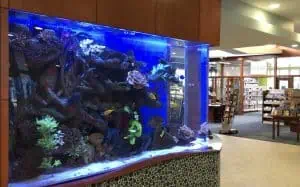
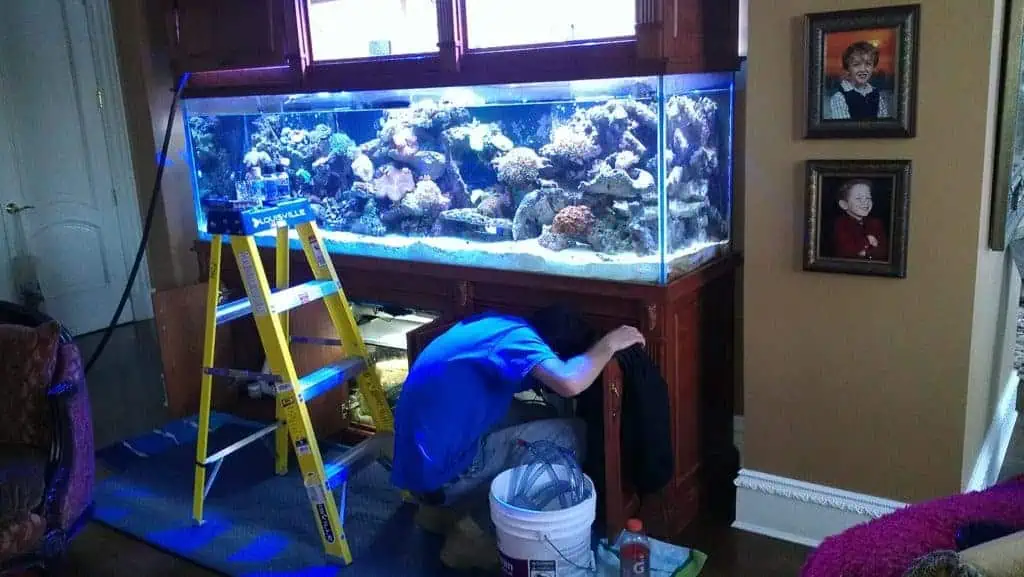
For reef tanks, the cycling process has additional layers. Live rock is a significant source of biological filtration in a saltwater system — the porous structure gives bacteria an enormous surface area to colonize — but it also introduces organic material that can cause ammonia spikes during the initial curing process. Protein skimmers, refugiums, and macroalgae all play roles in the overall nitrogen management of a reef system that go beyond the basic freshwater cycle. We’ve been setting up and maintaining reef tanks across Long Island since 2003, including systems as technically demanding as the Farmingdale State College Bioscience Aquarium Lab, and the reef cycling process is one of the areas where professional guidance pays for itself fastest.
Getting the Nitrogen Cycle Right in Your Nassau County Tank
The nitrogen cycle isn’t complicated once you understand what’s actually happening — bacteria colonize your filter, they convert toxic ammonia into less harmful compounds, and the whole process takes weeks, not days. The problems start when that process gets rushed, misunderstood, or disrupted by something as specific as Nassau County, NY’s chloramine-treated tap water throwing off your readings.
Test your water with a liquid reagent kit. Give the bacteria time to establish. Don’t clean your filter and do a large water change on the same day. And don’t trust clear water as a sign that everything is fine.
If you’re dealing with a tank that won’t cycle, a crash in an established system, or you simply want the process handled correctly from the start, we’ve been doing exactly this across Nassau County and all of Long Island for over twenty years. Reach out — we’re here seven days a week.