Summary:
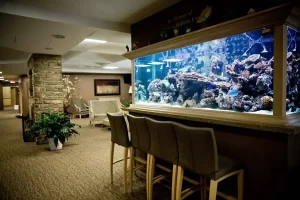
You’ve seen a reef tank somewhere — a restaurant in Garden City, a friend’s living room in Rockville Centre, maybe a hotel lobby — and now you can’t stop thinking about having one. That’s how it starts for most people. The problem is that the moment you go looking for real information, you run into a wall of content written by people who profit from your enthusiasm. Equipment brands, coral vendors, sponsored YouTubers — they all have a reason to make saltwater sound easier than it is. We’ve been setting up and maintaining aquariums on Long Island since 2003, and we’d rather give you the honest version.
Freshwater vs. Saltwater Aquariums: What's Actually Different
The core difference isn’t difficulty — it’s forgiveness. A freshwater tank will tolerate a skipped water change, a temperature swing, or a beginner’s mistake in a way that a saltwater system simply won’t. That’s not a reason to avoid saltwater. It’s just the truth you need to factor in before you decide.
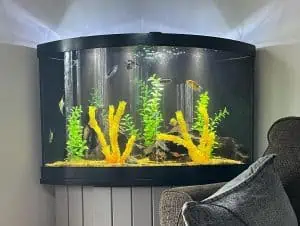
Freshwater tanks are genuinely more accessible at the entry level. The equipment costs less, the fish cost less, the chemistry is simpler, and the margin for error is wider. For someone who’s never kept fish before and wants to learn the rhythm of tank ownership, freshwater is a legitimate starting point — not a consolation prize.
Saltwater tanks, especially reef systems, are less forgiving of the same mistakes. That doesn’t mean they require more weekly effort — a well-established reef tank doesn’t necessarily take more time than a freshwater system. It means the consequences of neglect or error arrive faster and cost more. That’s the distinction most beginner guides miss.
How Much Does a Starter Saltwater Tank Actually Cost?
Cost is where most beginners get a rude awakening, and it’s where a lot of retailers go quiet. So here’s the straightforward version.
A functional freshwater community tank — tank, filter, heater, light, substrate, and initial fish — runs somewhere between $200 and $500 for a modest setup. It’s an accessible entry point. You can make mistakes, replace a fish for a few dollars, and learn without it being financially painful.
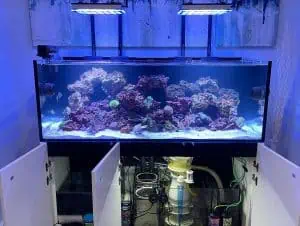
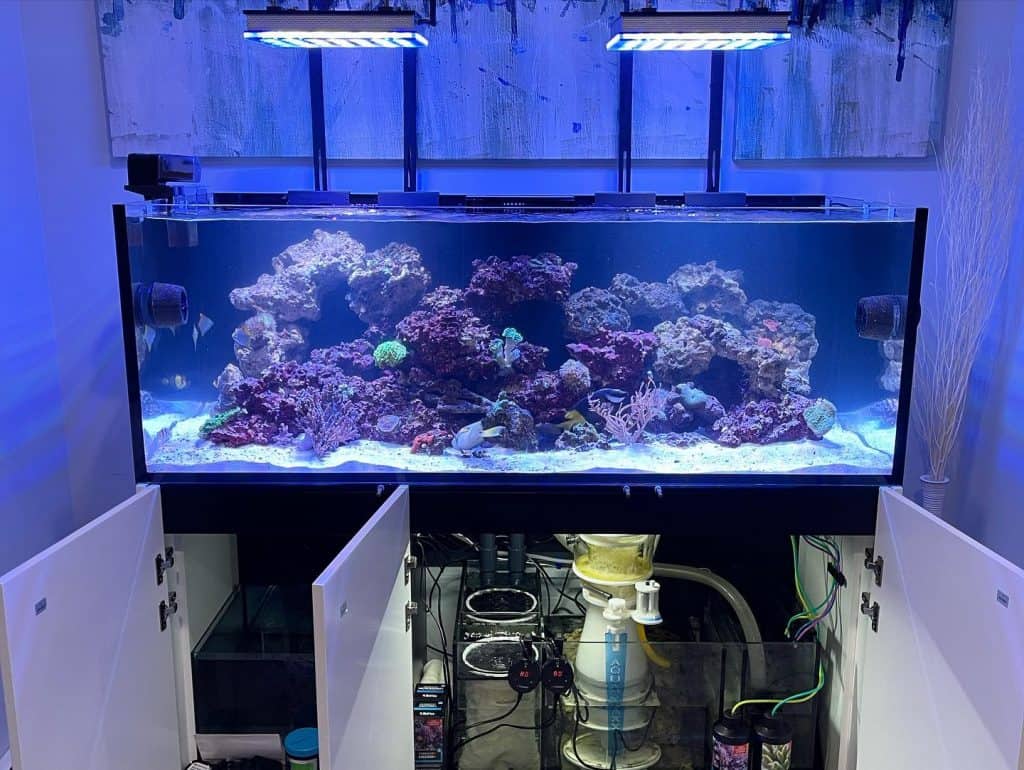
A saltwater fish-only-with-live-rock setup, commonly called a FOWLR tank, starts around $500 to $1,200. That’s before livestock. A full reef tank — the kind with corals, specialized lighting, a protein skimmer, powerheads, and the water chemistry equipment to keep it all stable — can run $1,000 to $2,500 or more for a modest 30-gallon system. And that’s the setup cost. Many saltwater hobbyists find they’ve doubled their initial spend within the first year as they upgrade equipment, add livestock, and solve problems they didn’t anticipate.
Part of what drives that cost is the chemistry. Serious reef keepers don’t use tap water — they use RO/DI water, which stands for reverse osmosis and deionized. Long Island tap water comes from a sole-source aquifer system, and while it’s safe to drink, it carries minerals, phosphates, and chloramines that can fuel algae growth and stress corals. An RO/DI unit is an additional equipment cost that most beginner guides either bury in a footnote or skip entirely.
The other cost factor people underestimate is livestock. Freshwater fish typically run a few dollars each. Saltwater fish range from $30 to well over $100 per specimen, and corals can run $50 to $250 or more. When you’re stocking a reef tank, the fish and coral are often the biggest line item — and because 98% of ornamental marine fish are wild-caught, quality sourcing and proper quarantine matter in a way they simply don’t with most freshwater species.
None of this is meant to scare you off. It’s meant to make sure that if you go in, you go in with clear eyes.
Should Beginners Start with Freshwater Before Going Saltwater?
This is the most common piece of advice in the hobby, and it’s worth examining honestly rather than just repeating.
The argument for starting with freshwater is real: you learn how tanks work, how the nitrogen cycle behaves, how fish respond to water quality, and how your own schedule holds up under the responsibility of regular maintenance. All of that is genuinely useful knowledge before you introduce $200 fish and $150 corals into the equation.
But the argument has limits. If you have zero interest in freshwater and you’re only drawn to the ocean ecosystem — the colors, the movement, the live coral — then spending a year maintaining a freshwater tank isn’t going to make you a better reef keeper in any meaningful way. It’ll just delay the hobby you actually want.
The better question isn’t “should I start with freshwater?” It’s “do I have the budget, the time, and the support structure for saltwater right now?” If the answer to all three is yes, there’s no rule that says you have to earn your way into the hobby you want. If the answer to any of those three is genuinely no, freshwater isn’t a downgrade — it’s the smarter move.
One thing worth knowing: the advice to “start small” doesn’t apply the same way in saltwater as it does in freshwater. A smaller saltwater tank is actually harder to maintain, not easier. Water parameters in a 10- or 15-gallon nano reef fluctuate faster and more dramatically than in a 40- or 55-gallon system. Larger water volumes are more stable, more forgiving, and more beginner-friendly in the saltwater world. It’s counterintuitive, but it’s one of those things that experienced reef keepers universally agree on.
The Saltwater Aquarium Cycle: What It Is and Why It Matters
Before any fish or coral goes into a saltwater tank, the tank has to complete something called the nitrogen cycle. This is the single most important concept for anyone setting up a saltwater system, and it’s also the most common point of failure for beginners who don’t understand what they’re waiting for.
The nitrogen cycle is the process by which beneficial bacteria colonize your tank’s filtration system and become capable of processing the waste your fish and coral produce. Without those bacteria, ammonia builds up in the water — and ammonia is toxic to fish. The cycle converts ammonia into nitrite, and then nitrite into nitrate, which is far less harmful and manageable through regular water changes.
In a freshwater tank, this process can establish in a couple of days. In a saltwater aquarium, it takes two to six weeks.

How Long Does It Take to Cycle a Saltwater Aquarium?
The honest answer is: two to six weeks, depending on how you set the tank up and what method you use to seed the cycle.
The most reliable approach is to use live rock — actual rock that already carries beneficial bacteria from an established marine environment. Live rock jumpstarts the bacterial colonization process and significantly reduces cycling time compared to starting with dry rock alone. Adding a liquid bacteria product alongside live rock can accelerate things further. Some hobbyists use a raw shrimp as an ammonia source to feed the bacteria during the fishless cycling phase — it sounds odd, but it works.
What you’re watching for during the cycle is a specific sequence of events. Ammonia levels spike first as waste begins to break down. Then nitrite rises as the first wave of bacteria starts processing that ammonia. Finally, nitrate appears as the second bacterial population converts nitrite — and at that point, with ammonia and nitrite both reading zero, the cycle is complete and the tank is ready for livestock.
The most expensive mistake beginners make is adding fish before the cycle finishes. Ammonia doesn’t just stress fish — it burns their gills and reduces their ability to absorb oxygen. A fish added to an uncycled tank is often a dead fish within days, and it’s a mistake that’s almost entirely avoidable with patience and a basic test kit.
During cycling, keep the lights off as much as possible to avoid feeding early algae growth, and test the water every few days so you can track where you are in the process. When the cycle completes, do a significant water change — somewhere in the range of 25 to 50 percent — before adding your first fish. This clears out the elevated nitrate levels that accumulated during the cycle and gives your livestock the cleanest possible start.
Hair Algae in a New Reef Tank: What It Means and What to Do
If you set up a saltwater tank, complete the cycle, add your first fish, and then watch green filamentous hair algae start taking over your rocks and substrate — you are not failing. You are having the most normal experience in reef keeping.
Hair algae is almost universal in new reef tanks during the weeks immediately following the cycling phase. The reason is straightforward: cycling produces elevated levels of nitrates and phosphates, and hair algae is very good at consuming them. It’s essentially the tank’s first attempt at self-regulation, and while it looks alarming, it’s a sign of a working biological system — not a broken one.
The way through it is nutrient export. That means consistent water changes to physically remove dissolved nutrients, making sure you’re not overfeeding your fish, improving water circulation so detritus doesn’t settle and decompose in dead spots, and adding a clean-up crew. Hermit crabs, turbo snails, and emerald crabs are all effective at grazing hair algae off rocks and glass. A protein skimmer — which pulls dissolved organic compounds out of the water before they break down into nutrients — is one of the most effective long-term tools for keeping hair algae under control in a reef system.
Most hair algae outbreaks in new tanks resolve within four to twelve weeks as the biological system matures and nutrient levels stabilize. The hobbyists who panic and tear the tank down during this phase are the ones who never get to see what comes after it — a stable, balanced reef ecosystem that’s genuinely one of the most rewarding things you can keep in your home. Knowing that this phase is coming, and knowing what to do about it, is most of the battle.
Ready for a Saltwater Tank? Here's How to Know
Here’s the honest summary: saltwater isn’t harder than freshwater in terms of weekly effort. It’s less forgiving of the same mistakes, and it costs more to get right from the start. If you have the budget for a proper setup, the time to stay on top of water changes and parameter testing, and either the knowledge or the support to navigate the early stages — cycling, the hair algae phase, stocking choices — saltwater is absolutely achievable.
If any of those three pieces aren’t in place yet, freshwater isn’t a step backward. It’s just the smarter entry point.
For Nassau County residents who are serious about saltwater, the proximity to the water is part of what makes it feel worth it. Whether you’re in Merrick, Manhasset, or Long Beach, there’s something genuinely satisfying about bringing a piece of that ecosystem inside — and doing it right the first time.
If you want to talk through what a starter saltwater setup would actually look like for your space, we’ve been having that conversation with Nassau County homeowners and businesses for over 20 years. Reach out and let’s figure out what makes sense for you.