
Summary:
You dechlorinate your water. You follow the instructions on the bottle. You do your water changes on schedule. And yet something keeps going wrong — fish that don’t thrive, corals that slowly decline, algae that won’t quit no matter what you try.
Here’s the part most online guides skip entirely: the advice they’re giving you wasn’t written for Nassau County water. It was written for somewhere else, with a completely different water source. And that gap matters more than most hobbyists realize.
What’s coming out of your tap on Long Island has a specific chemical profile — and once you understand it, a lot of those frustrating problems start to make a lot more sense.
What Makes Nassau County Tap Water Different
Unlike most of the United States, Nassau County has no rivers, no reservoirs, and no surface water in its drinking supply. Every drop comes from underground aquifers — specifically the Upper Glacial, Magothy, and Lloyd aquifer layers beneath Long Island. The Magothy is the largest and the one most Nassau County water districts draw from.
That geological reality shapes everything. Aquifer water picks up minerals, legacy contaminants, and agricultural runoff as it percolates through the ground. Decades of suburban development, fertilizer use, industrial activity, and cesspool leaching have left a chemical fingerprint in Nassau County’s groundwater that is genuinely distinct from what you’d find in Chicago, Los Angeles, or even New York City — which draws from Catskill watershed reservoirs, not wells.
For aquarium keepers, this means your source water carries a different burden than what most national guides account for. You’re not just dealing with chlorine or standard municipal treatment. You’re dealing with Nassau County’s specific aquifer chemistry.
Why Chloramine Is the Hidden Threat in Nassau County Tap Water
Nassau County municipal water suppliers use chloramine as a disinfectant — and this is where a lot of aquarium problems quietly begin. Chloramine replaced chlorine in many water systems because it lasts longer in supply pipes and produces fewer toxic byproducts in the distribution process. That’s good for drinking water safety. It’s not good for your tank.
Here’s the problem most hobbyists don’t know: chloramine doesn’t off-gas the way chlorine does. You can’t just let a bucket of Nassau County tap water sit out overnight and expect it to be safe. Chloramine stays in the water until you actively remove it — and the way most people try to remove it actually creates a new problem.
Standard dechlorinators work by breaking chloramine apart. That sounds like a solution, but the breakdown releases ammonia directly into your tank. The math works out to roughly 1.3 parts per million of ammonia per mole of chloramine treated — and 1.3 ppm of ammonia is acutely dangerous to reef inhabitants. Your biological filter may handle it, or it may not. Either way, you’re starting every water change with an ammonia spike you didn’t know you were creating.
The fix isn’t to use more dechlorinator. It’s to use the right one — a product specifically formulated to neutralize chloramine and its ammonia component simultaneously, like Seachem Prime — or better yet, to stop relying on tap water for your water changes entirely.
An RO/DI system with catalytic carbon pre-filtration removes chloramine before it ever touches your tank. Standard carbon blocks aren’t sufficient for chloramine; the contact time required is too long and the chemistry is different. Catalytic carbon is specifically designed for it.
For reef keepers especially, this isn’t optional. A single bad water change can crash a biological filter, spike ammonia, and wipe out coral tissue that took months to grow. The frustrating part is that it looks like a mystery — the tank was fine, then it wasn’t — when the cause was sitting in the bucket the whole time.
Nassau County's Seasonal Water Chemistry — Why Your Protocol Can't Stay the Same Year-Round
Here’s something no national aquarium guide will tell you: the water coming out of your Nassau County tap in February is not the same water that came out in August. And if you set up your treatment protocol once and haven’t revisited it, you may be running blind during the months when your source water is at its worst.
The reason is aquifer recharge. When rain and snowmelt percolate through Nassau County’s suburban landscape — through lawns treated with fertilizer, through soil above old cesspools, through ground that has absorbed decades of runoff — they carry nitrates down into the aquifer. That recharge happens most intensively during the cold months, which means nitrate levels in Long Island groundwater tend to peak in winter and early spring.
For aquarium hobbyists, this creates a specific seasonal hazard. If you’re doing water changes with untreated tap water during winter, you may be adding nitrates to your tank rather than removing them. The whole point of a water change is to dilute and export waste — but if your source water already carries elevated nitrates, you’re working against yourself.
Summer brings a different challenge. Higher evaporation rates mean you’re topping off more frequently, and every top-off with untreated tap water adds to the chemical load in your system. Salinity swings become more common. Mineral concentrations can creep up over time in ways that don’t show up until something goes wrong.
There’s also the issue of seasonal treatment changes by the water utility itself. Some districts adjust disinfectant levels or switch protocols at certain times of year, which can catch aquarists off guard even if their usual approach has been working.
The practical takeaway: test your source water, not just your tank water. And test it more than once a year. What you’re working with changes, and your approach should account for that.
Aquarium Fish Supplies That Actually Address Long Island Water Problems
Once you understand what’s in Nassau County tap water, the supply decisions become a lot clearer. This isn’t about buying more products — it’s about buying the right ones for your specific source water, rather than whatever the generic guide recommends.
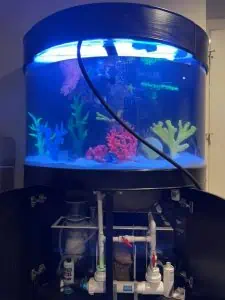
The single most impactful upgrade most Long Island hobbyists can make is an RO/DI system. Reverse osmosis combined with deionization resin strips out chloramine, nitrates, PFAS compounds, dissolved solids, and the mineral load that interferes with reef chemistry — giving you a genuinely clean baseline for every water change. It’s not a luxury for serious reefers. For anyone dealing with Nassau County source water, it’s the foundation everything else is built on.

Salt Water Aquarium Supply Essentials for Nassau County Reef Keepers
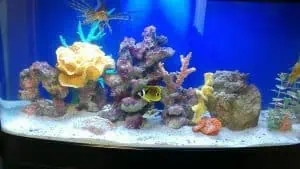
For saltwater and reef tanks, the supply chain starts with your water source and works outward from there. An RO/DI unit with a catalytic carbon stage handles chloramine properly — standard carbon blocks don’t provide enough contact time to break it down. The DI resin stage then catches whatever the membrane misses, bringing your TDS to near zero before you ever add salt mix.
From that clean baseline, you’re mixing your own saltwater at the parameters your reef actually needs: specific gravity between 1.024 and 1.026, alkalinity between 8 and 12 dKH, calcium around 420 to 440 ppm, and ammonia and nitrite at absolute zero. When you start with RO/DI water, hitting those targets consistently becomes dramatically easier because you’re not fighting whatever the aquifer sent you that week.
A quality refractometer and a reliable liquid test kit are non-negotiable. Test strips give you a rough sense of where things are, but for reef tanks where small swings in alkalinity or calcium can stress or kill SPS and LPS corals, you need numbers you can trust.
Alkalinity matters especially because it’s what corals consume to build their skeletons — and it’s the parameter most likely to be thrown off by source water with elevated bicarbonate, which is common in Nassau County’s mineral-rich groundwater.
If you’re not yet running RO/DI and you’re using a dechlorinator as your primary treatment, Seachem Prime is the product most commonly recommended for chloramine-treated water. It neutralizes both the chloramine and the ammonia that results from breaking it down. But it needs to be dosed correctly every single time — there’s no margin for error when your source water is chloramine-treated. One underdosed water change can undo weeks of stable parameters.
Aquarium Pet Supplies for Freshwater Tanks — Nassau County Tap Water Matters Here Too
Freshwater hobbyists often assume the chloramine and nitrate conversation only applies to reef tanks. It doesn’t. Chloramine is just as harmful to freshwater fish and the beneficial bacteria that run your biological filter as it is to coral. The nitrogen cycle that keeps your freshwater tank stable depends entirely on a healthy colony of nitrifying bacteria — and chloramine kills them.
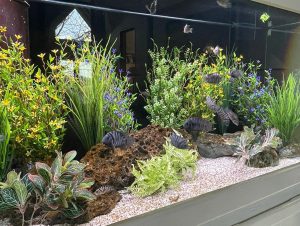
For community tanks, planted tanks, and cichlid setups, the baseline supply needs are similar: a chloramine-specific water conditioner used correctly at every water change, or an RO/DI system for hobbyists who want to eliminate the guesswork. For planted tanks especially, starting with RO/DI water and remineralizing to your target parameters gives you precise control over the mineral content your plants and fish are living in.
A liquid test kit covering ammonia, nitrite, nitrate, and pH is the minimum for any freshwater tank. If you’re in Nassau County and you’ve been struggling with persistent algae — particularly the brown diatom blooms that show up in new and established tanks alike — elevated silicates and phosphates in your source water are a likely contributor. These are invisible to the eye and won’t show up on a basic test strip, but they feed algae reliably. RO/DI filtration removes them.
For hobbyists who don’t want to invest in a full RO/DI system right away, buying pre-made RO/DI water from a local aquarium shop is a reasonable bridge solution. It gives you the same clean baseline without the upfront equipment cost, and it lets you see the difference in your tank before committing to a system. The improvement is usually noticeable within a few water change cycles — less algae, more stable parameters, fish that behave more actively and eat more readily.
The broader point is that aquarium water quality in Nassau County isn’t just a reef keeper’s concern. Anyone keeping fish in Long Island tap water is working with source water that has a specific chemical profile — and the supplies that address it are the same whether your tank holds clownfish and coral or tetras and java fern.
Getting Your Nassau County Aquarium Water Right — Where to Start
Most of the water quality problems Long Island hobbyists run into aren’t bad luck or bad fishkeeping. They’re a predictable result of using source water that was never designed with aquariums in mind, treated with methods that don’t fully account for what Nassau County’s aquifers actually carry.
The good news is that once you understand the specific challenges — chloramine, seasonal nitrate variation, dissolved solids, legacy contaminants — the path forward is clear. Test your source water. Use the right treatment for chloramine-treated water. Consider RO/DI filtration if you’re serious about reef keeping or if you’ve been fighting problems without a clear cause. And revisit your protocol seasonally, because your tap water isn’t static.
We’ve been working with Long Island water and Long Island tanks since 2003, and we’ve seen these patterns play out in homes and offices across Nassau County. If you’re not sure where your water stands or what your tank actually needs, Island Fish & Reef is here to help you figure it out.
]