Summary:
You’ve done the research. You know what you want. But every time you try to figure out what professional aquarium installation actually costs on Long Island, you hit a wall — either no pricing at all, or national averages that don’t reflect what things actually cost here. That’s frustrating, and it’s exactly why a lot of people in Nassau County quietly abandon a project they were genuinely excited about. This guide gives you real context: what drives the cost, what a professional installation actually covers, and what to watch out for if your home was built before 1980.
What Does a Professional Aquarium Setup Actually Cost on Long Island?
There’s no single number here — and anyone who gives you one without knowing your space, your goals, and your tank type is guessing. That said, there are realistic ranges worth understanding before you start making calls.
A professionally installed display tank in the 29- to 75-gallon range — properly equipped with filtration, lighting, cabinetry, and initial livestock — typically runs into the hundreds of dollars for equipment alone before labor and customization are factored in. Once you move into the 100- to 200-gallon range, you’re looking at a meaningfully larger investment that accounts for structural prep, dedicated electrical circuits, and a more complex life support system. Custom reef builds and large-scale residential statement pieces can reach well into five figures depending on scope and species selection.
Commercial installations — think a dental practice off Hempstead Turnpike or a hotel lobby near the Meadowbrook State Parkway — carry their own cost structure. Monthly professional maintenance for commercial systems typically runs between $300 and $1,500 or more, depending on tank size and complexity. For residential custom systems, that ongoing maintenance figure generally falls between $150 and $400 per month. As a useful planning benchmark, budget roughly 10 to 15 percent of your total installation investment per year for ongoing maintenance.
Saltwater Aquarium Installers on Long Island: Why Reef Tanks Cost More
If you’re planning a reef tank, expect the cost conversation to be different from a freshwater build — and for good reason.
Saltwater systems, particularly reef tanks, are the most technically demanding aquarium type to install correctly. The livestock alone — corals, invertebrates, and marine fish — can cost hundreds of dollars per specimen. A single unhealthy addition can crash an established system overnight, which is why the quarantine step before stocking isn’t optional for any serious installation. We run an on-site quarantine and holding facility specifically to make sure nothing enters your tank that hasn’t been properly assessed first. That’s an infrastructure investment most hobbyist-level installers simply don’t have.
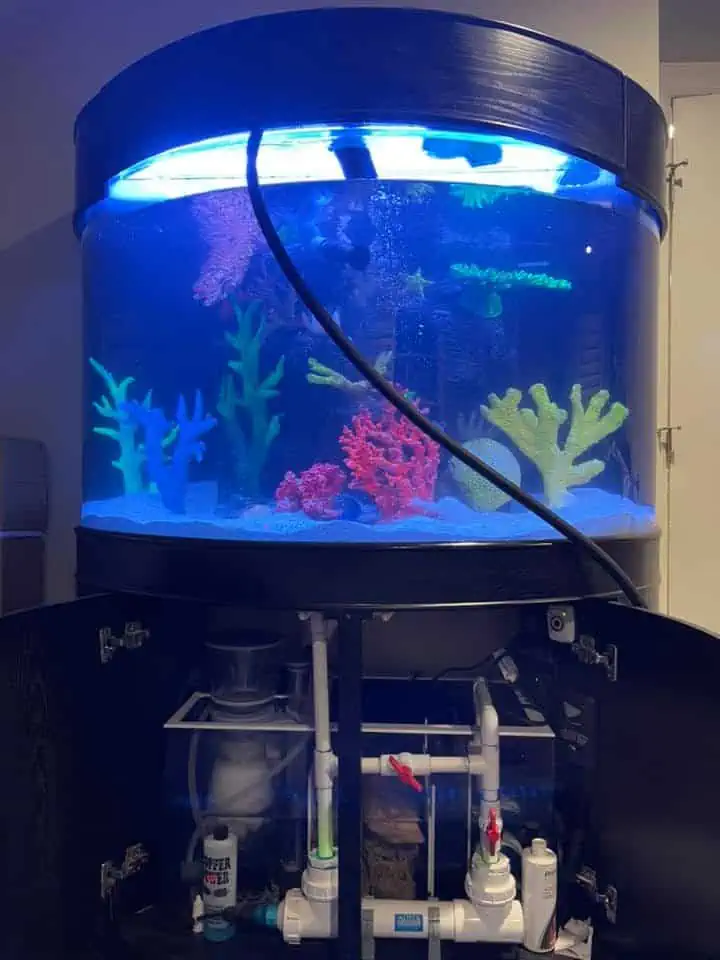
Beyond livestock, reef systems require precision water chemistry management, high-output lighting, protein skimmers, sumps, and often a reverse osmosis water supply. The plumbing and electrical requirements are more involved than a freshwater build, and the margin for error is smaller. A freshwater planted tank is forgiving — a reef is not.
There’s also a counterintuitive truth worth knowing: larger tanks are often easier to keep stable than smaller ones. A 200-gallon system has more water volume to buffer against temperature swings and chemical fluctuations. A 40-gallon reef tank can crash faster than a 150-gallon one because there’s simply less margin. This is one of the reasons we have conversations with clients about tank sizing early in the process — the “smaller is simpler” assumption doesn’t always hold in saltwater.
For Nassau County buyers planning a reef installation, the combination of proper structural prep, a professional life support system, and sourcing livestock through a quarantine facility is what separates a tank that thrives from one that becomes an expensive lesson. The cost difference between doing it right the first time and retrofitting a failed DIY setup is almost always larger than people expect.
The Hidden Costs: What Nassau County Buyers Usually Forget to Budget For
There’s a pattern that shows up constantly in aquarium projects: buyers budget carefully for the tank itself, then get surprised by everything that surrounds it.
Industry data puts the “forgotten costs” add-on at roughly 15 to 20 percent above the initial build estimate. For a Nassau County homeowner planning a custom installation, that gap shows up in a few specific places. Cabinetry is often the first surprise — a custom stand and canopy built to match an existing interior can add significant cost that wasn’t in the original mental budget. Dedicated electrical circuits are another one. Most large aquariums require their own circuit, and if your home’s panel is already at capacity (common in Nassau County homes built in the 1950s and 1960s), that means an electrician visit before installation even begins.
Water supply is a third factor that often gets overlooked. Reef and planted tanks benefit from purified water — a reverse osmosis and deionization (RO/DI) system is a meaningful addition to the setup cost but pays for itself quickly in reduced algae problems and healthier livestock.
Then there’s the ongoing side. A lot of buyers focus entirely on the installation number and don’t think through what year two looks like. Ongoing professional maintenance is what keeps the system performing the way it looked on day one. We always give clients a complete picture of long-term maintenance costs before any work begins — not because it’s a sales tactic, but because a client who gets surprised by ongoing costs six months in isn’t a happy client. Knowing the full picture upfront is just the right way to start a project.
Large Aquarium Setup in Nassau County: The Floor Load Question Nobody Talks About
Here’s the conversation that stops more Nassau County aquarium projects than any other: “Can my floor actually handle this?”
It’s a legitimate question, and the fact that most aquarium companies don’t address it directly is a real problem. Water weighs 8.34 pounds per gallon. A fully installed 120-gallon aquarium — tank, stand, water, substrate, live rock — typically lands somewhere between 1,100 and 1,500 pounds. A 180-gallon reef build with a deep sand bed and live rock can easily exceed 2,200 pounds. Residential floors are generally engineered to handle 40 to 50 pounds per square foot of live load. Run the math on a large tank’s footprint and you’ll see why this question matters.
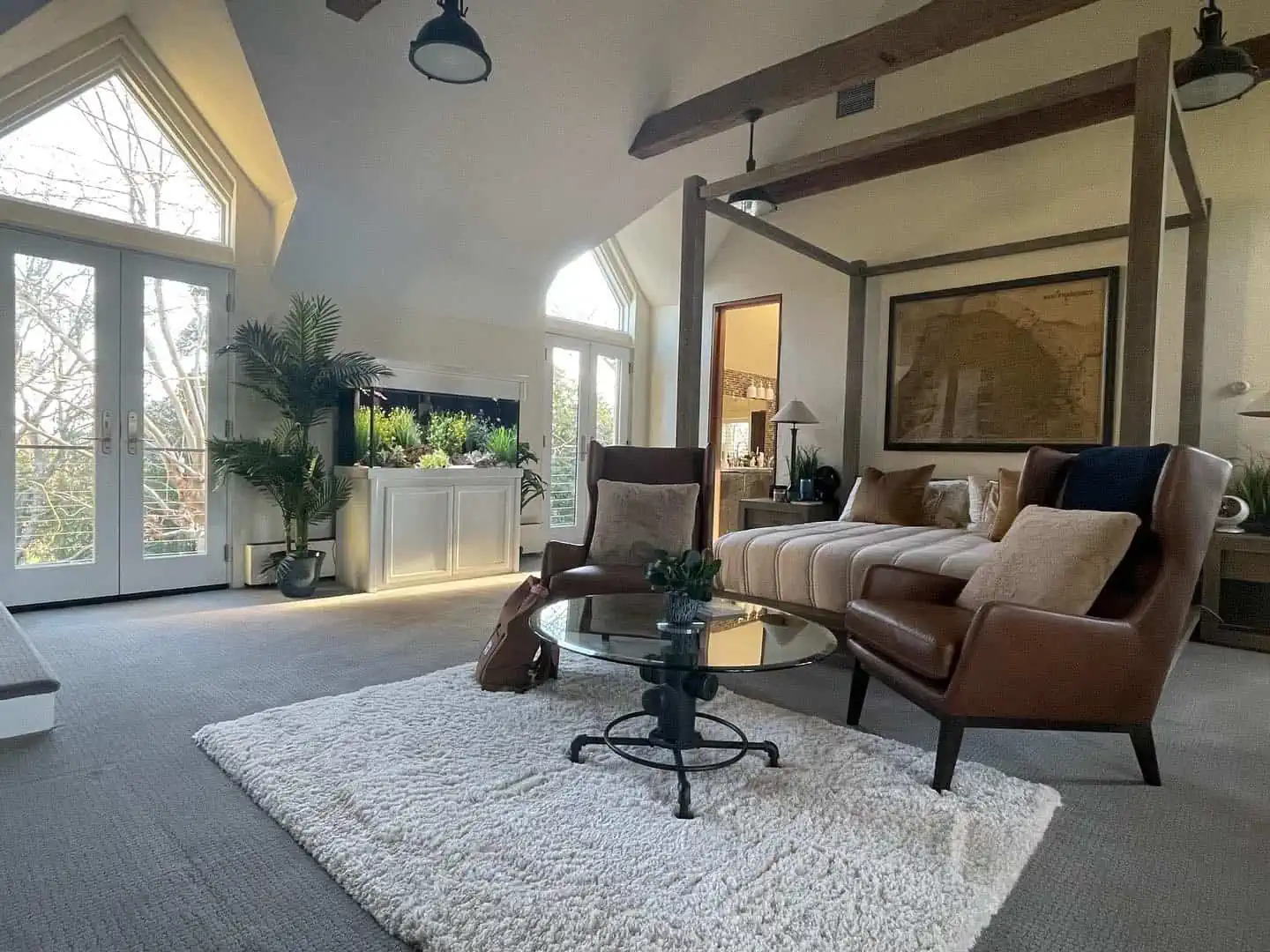
Nassau County’s housing stock makes this especially relevant. The average single-family home in the county is 73 years old — most of the residential base was built during the post-WWII suburban boom of the late 1940s through the 1960s. Those homes were not designed with a 2,000-pound aquarium in mind. That doesn’t mean a large installation isn’t possible — it means it requires a professional assessment before anything else happens.
What a Pre-Installation Structural Assessment Actually Covers
A structural assessment before installation isn’t a formality — it’s the step that determines whether your project is safe, and what it will actually take to execute it correctly.
When we begin the consultation process, we look at the full picture of your installation site. That means evaluating floor joist orientation and spacing, identifying whether the tank can be positioned over a load-bearing wall or beam, and assessing whether the planned placement runs parallel or perpendicular to the joists — a detail that makes a significant difference in how weight is distributed. Positioning a large tank perpendicular to floor joists spreads the load across multiple structural members. Running it parallel concentrates that load on fewer joists, which is a problem in any home, but especially in an older one.
Beyond the structural side, the assessment covers electrical requirements. Large aquariums typically need dedicated circuits — sometimes more than one — and the electrical panel needs to support that load. We coordinate with licensed electricians when additional circuits are required, and we flag this early so there are no surprises mid-project.
Plumbing access is another consideration, particularly for systems with sumps or external filtration that require drain lines or dedicated water supply. In a 1958 split-level in Garden City or a 1962 ranch in Levittown, the plumbing path that works on paper sometimes requires creative problem-solving in practice.
For buyers who’ve been quietly sitting on an aquarium project because they weren’t sure their home could handle it — this is the conversation to have first. The assessment either confirms you’re ready to move forward or tells you exactly what needs to happen before you do. Either outcome is more useful than continuing to wonder.
Professional Aquarium Installation vs. DIY: When It Actually Matters
The honest answer: it depends on the size and type of system you’re building — but the gap between professional and DIY widens fast once you’re past the 75-gallon mark.
For a small freshwater setup, a capable hobbyist with time and patience can produce a solid result. The stakes are lower, the equipment is simpler, and a mistake usually means a water change, not a structural repair. But once you’re talking about a large display tank, a reef system, or a commercial installation, the calculus shifts considerably.
Professional installation, done correctly, can extend the functional life of a system by up to 50 percent through optimized plumbing, properly sized filtration, and structural support that doesn’t compromise over time. That’s the difference between a system built on correct foundations and one that was assembled without accounting for long-term load, flow rates, or livestock compatibility.
The other side of the DIY equation is what happens when something goes wrong. A slow leak in a poorly sealed 150-gallon tank in a Nassau County home can cause tens of thousands of dollars in floor and wall damage. A system stocked without proper quarantine can crash an entire reef in 48 hours. The cost of fixing a failed DIY installation — structural repairs, replacing livestock, rebuilding the filtration system — almost always exceeds what professional installation would have cost from the start.
We’ve been doing this since 2003, and the calls we get to rescue or rebuild failed setups are a consistent part of the business. Not every DIY project fails, but the ones that do tend to fail in expensive and avoidable ways. If you’re investing seriously in this — and a custom aquarium in Nassau County is a serious investment — the professional route is the one that protects it.
How to Get Started with Professional Aquarium Installation on Long Island
If you’ve made it this far, you’re probably past the “should I do this?” stage and into the “how do I do this right?” stage. That’s exactly where this conversation starts.
The most important thing to know is that a consultation isn’t a commitment — it’s a way to get real answers about your specific space, your goals, and what the full project will actually involve and cost. No surprises, no vague estimates. By the end of the process, you’ll have a complete picture of both the installation and the long-term maintenance costs before any work begins.
Island Fish & Reef has been serving Nassau County and all of Long Island since 2003. We’re fully licensed and insured, operate a fleet of four service vehicles seven days a week, and have completed everything from residential reef builds to the Farmingdale State College Bioscience Aquarium Lab installation. If you’re ready to stop researching and start planning, reach out to Island Fish & Reef and let’s talk through what you have in mind.