Summary:
You’ve got a tank you care about. Maybe it’s a reef system you’ve been building for years. Maybe it’s a custom saltwater display in your living room or your office lobby. Either way, you’ve reached the point where you’re considering handing the maintenance over to a professional — and now you’re trying to figure out how to tell a good service from a bad one.
That’s a harder question than it should be. Most providers look similar from the outside. So before you commit to anyone, here are the five things worth demanding — and why each one actually matters.
What Saltwater Tank Maintenance Should Actually Include at Every Visit
The single biggest gap between a professional aquarium maintenance service and a casual “tank cleaning” is what happens at each visit. A lot of providers will scrub the glass, top off the water, and call it done. That’s not maintenance — that’s housekeeping.
Real maintenance means water testing at every single visit. For a saltwater or reef system, that’s not one or two parameters — it’s ammonia, nitrate, nitrite, pH, salinity, alkalinity, calcium, and magnesium at minimum. Any one of those drifting out of range can stress or kill livestock before you notice anything looks wrong. The problems that are invisible to the eye are usually the ones that do the most damage.
Why the Same Technician at Every Visit Makes a Real Difference
This one gets overlooked, but it matters enormously — especially for saltwater and reef systems that have their own chemistry quirks, equipment personalities, and livestock history.
When you get a different technician at every visit, that person is essentially starting from scratch. They don’t know that your return pump has been running a little warm lately. They don’t know that one of your fish was off its feed two weeks ago. They don’t have a baseline for what “normal” looks like in your specific tank. So when something is subtly off, they’re less likely to catch it.
Consistent technician assignment means the person who shows up actually knows your system. They’ve seen it week after week. They know what healthy looks like, and they notice when something has shifted. That kind of familiarity is what turns a maintenance visit from a routine cleaning into genuine early-warning monitoring.
When you’re evaluating a service, ask directly: will I have a consistent technician? If the answer is vague — “we’ll do our best” or “it depends on scheduling” — that’s worth weighing carefully. For a living ecosystem with real stakes, “it depends” isn’t a reassuring answer.
This is something we hear about constantly from Nassau County clients who’ve tried other services before coming to us. The complaint isn’t usually that the other company was careless — it’s that nobody who showed up ever really knew the tank. One client who came to us after cycling through three different providers put it plainly: the tank always did better when he was managing it himself, because at least he knew its history. Consistency isn’t a luxury. It’s the baseline.
What Saltwater Aquarium Maintenance Documentation Should Look Like
Here’s a question worth asking any service you’re considering: do you keep records of what you tested and what you found at each visit?
A lot of providers don’t. They show up, do the work, and leave — with no written record of what the parameters were, what was adjusted, or what they observed. That might seem fine when things are going well. But when something goes wrong — and eventually, something always does — you want a history to look back at. Was the alkalinity trending down over the last three visits? Was there a nitrate spike two weeks before the fish started showing stress? Without documentation, you’re guessing.
Service notes and parameter logs are what turn individual visits into a longitudinal health record for your tank. A good service tracks what was tested, what the numbers were, what was adjusted, and any observations about livestock or equipment. Over time, that record becomes genuinely useful — you can see trends, catch slow drifts before they become crises, and have an honest conversation with your technician about what’s changing and why.
For saltwater fish tank maintenance specifically, this level of documentation is especially important because reef chemistry is not static. Parameters shift with livestock load, evaporation, coral growth, feeding habits, and seasonal temperature changes. A provider who isn’t tracking those shifts over time is only ever working with a snapshot — not a picture of where your system is actually headed.
Ask to see a sample service report before you commit. If a provider can’t produce one, or if it’s just a checkbox form with no actual data, that tells you something important about how seriously they take the work.
Fish Tank Upkeep You Shouldn't Have to Think About
One of the reasons people hire a professional aquarium maintenance service in the first place is to stop thinking about the tank constantly. Not because they don’t care — clearly they do — but because they have demanding schedules, and the mental load of monitoring parameters, tracking equipment wear, and staying ahead of algae cycles is more than they want to carry.
That’s a completely reasonable thing to want. The right service makes the tank something you enjoy rather than something you manage. But that only works if the service is actually handling everything — not just the visible stuff, while leaving the slow-burn problems for you to discover on your own.
Licensing and Insurance: Why It Matters More Than You Might Think
This one is easy to overlook because it feels administrative. But it’s worth asking about directly, especially if your tank is in your home.
A significant portion of the aquarium maintenance market — particularly at the lower end — consists of individuals who are neither licensed nor insured. They may be knowledgeable and well-intentioned. But if something goes wrong in your home, whether that’s a water line failure, a cracked sump, or damage to your flooring or cabinetry, an uninsured technician leaves you with no recourse. You’re absorbing the cost of a problem that happened on someone else’s watch.
For Nassau County, NY homeowners, this is particularly relevant. Property values here are substantial — the median home value in the county sits well above $680,000 — and the homes where high-end custom aquariums tend to be installed are often the ones where a water incident would be most costly. A 200-gallon reef system failing in a finished basement or a custom-built entertainment space is not a small problem.
Licensing and insurance aren’t just paperwork. They’re the difference between a professional relationship with real accountability and an informal arrangement where you’re assuming all the risk. Any reputable aquarium maintenance service should be able to confirm both without hesitation. If there’s any hedging on that question, keep looking.
We’ve been fully licensed and insured since we started in 2003. It’s not something we mention as a selling point so much as something we consider basic. If you’re inviting someone into your home to work on a system that holds hundreds of gallons of water and thousands of dollars of livestock, that’s the minimum standard.
Does the Service Have a Quarantine Protocol for New Livestock?
This is the question most people don’t think to ask — and it’s one of the most important ones.
If a maintenance service also handles stocking, or if they’ll ever be introducing new fish or coral into your system, you need to know how they handle disease prevention. Introducing an animal that’s carrying a pathogen directly into an established tank is one of the fastest ways to lose everything you’ve built. Ich, velvet, bacterial infections — these spread quickly in a closed system, and by the time you see symptoms, the damage is often already widespread.
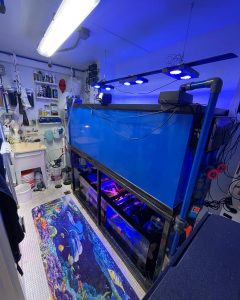
A professional service with real standards maintains a quarantine and holding facility where new livestock is observed before introduction. That means animals are held separately, monitored for signs of illness, and only moved into a client’s tank once they’ve been cleared. It’s not glamorous, but it’s the practice that separates providers who take animal welfare seriously from those who are just moving product.
This matters especially for reef hobbyists in Nassau County, NY who have years of investment in coral colonies and carefully curated fish populations. A single careless introduction can unravel a system that took years to develop. When you’re evaluating a service, ask specifically: do you quarantine new livestock before introducing it to a client’s tank? And if so, where and for how long?
We maintain an on-site quarantine and holding facility precisely because we’ve seen what happens when this step gets skipped. It’s not a differentiator we invented for marketing purposes — it’s a practice we built into the operation because it’s the right way to do the work.
How to Choose an Aquarium Maintenance Service You Can Actually Trust
The five things covered here — thorough water testing at every visit, consistent technician assignment, documented service records, verified licensing and insurance, and a real quarantine protocol — aren’t a wish list. They’re the baseline for what professional aquarium maintenance service should look like. Any provider worth hiring should be able to confirm all five without hesitation.
If you’re in Nassau County, NY and you’ve been sitting on this decision for a while, that’s understandable. Handing over a system you care about to someone you don’t know yet takes a certain amount of trust. The goal of this post is to give you the framework to evaluate that trust before you extend it.
When you’re ready to have a real conversation about what your tank needs, Island Fish & Reef is here. We’ve been doing this work across Long Island since 2003, and we’re happy to start with a straightforward assessment of where your system stands.