
Summary:
Most people who get into saltwater aquariums don’t quit because they lost interest. They quit because something went wrong early — a tank crash, a round of unexplained fish deaths, an algae bloom that wouldn’t clear — and they didn’t have the foundation to fix it. Research suggests 30 to 50 percent of new saltwater aquarium owners discontinue the hobby within 18 months. That number isn’t about difficulty. It’s about preventable mistakes made in the first few weeks. This post covers what those mistakes are, what proper saltwater aquarium maintenance actually looks like, and why the gap between a starter kit and a working reef system is wider than most beginners expect.
What a Saltwater Fish Tank Starter Kit Actually Includes — and What It Doesn't
Starter kits are marketed as everything you need to get going. In practice, they’re a starting point — and not always a good one for saltwater. Most include a tank, a basic filter, a heater, and sometimes lighting. A few throw in a hydrometer or a small bag of substrate. What they don’t include is usually the stuff that actually determines whether your system survives.
The omissions aren’t random. They’re the items that require more knowledge to use correctly, cost more to include, or simply don’t fit the “beginner-friendly” packaging story. But when those items are missing, the beginner pays for it later — in dead livestock, failed cycles, and equipment they end up replacing anyway.
What Most Beginner Saltwater Aquarium Kits Leave Out
The first thing most starter kits skip is a proper water source. Saltwater systems — especially reef tanks — require RODI water: water that’s been filtered through reverse osmosis and deionization to remove chloramines, phosphates, nitrates, silicates, and other contaminants. This matters more in Nassau County than most places.
Long Island tap water contains chloramines, which standard dechlorinators don’t fully address, along with phosphates and nitrates that feed algae and stress marine life from day one. Using tap water in a saltwater system doesn’t just introduce impurities — it introduces the exact nutrients that fuel the algae blooms beginners spend months trying to eliminate.
The second major gap is test kits. Not the basic strip tests that come bundled with some kits — those aren’t accurate enough for saltwater. A functioning saltwater system requires monitoring ammonia, nitrite, nitrate, pH, salinity, and in reef tanks, alkalinity, calcium, magnesium, and phosphate. That’s eight to twelve parameters, and each one tells you something different about what’s happening in the water. Without reliable test kits, you’re flying blind.
Fish can look perfectly healthy while parameters are drifting toward dangerous levels. Corals often show stress — color loss, polyp retraction — before fish do, and by the time fish show symptoms, the tank may already be in crisis.
Starter kits also tend to include filtration that’s adequate for freshwater but undersized for saltwater. A protein skimmer — which removes dissolved organic waste before it breaks down into ammonia — is considered standard equipment for any serious saltwater setup but rarely appears in beginner kits. The lighting included in most kits is designed for fish visibility, not coral health. If you ever want to keep coral, that lighting will need to be replaced. And the swing-arm hydrometer that sometimes comes in a kit is notoriously inaccurate compared to a refractometer, which is what most experienced hobbyists use to measure salinity.
None of this means a starter kit is worthless. It means the kit is the beginning of a list, not the end of one. The practical problem is that most beginners don’t find out what’s missing until after they’ve already bought the kit, set it up, and started losing fish. By that point, the cost of replacing what didn’t work often exceeds what a better-planned setup would have cost from the start.
The Nitrogen Cycle: The Step Most Beginners Rush — and Regret
Before any livestock goes into a new saltwater tank, the system needs to complete its nitrogen cycle. This is the process by which beneficial bacteria colonize the tank and convert ammonia — produced by fish waste, uneaten food, and decaying matter — first into nitrite, then into nitrate. Both ammonia and nitrite are toxic to fish and coral at even low concentrations. Until the cycle is complete and both read zero, the tank isn’t ready.
A proper cycle takes two to six weeks. That’s not a suggestion — it’s a biological timeline. The bacteria that handle this conversion need time to establish and multiply, and there’s no shortcut that reliably compresses that window without risk. Rushing the cycle is one of the most consistent causes of early livestock loss, and it’s one of the most common mistakes beginner guides gloss over because it’s not exciting content.
The way you know the cycle is complete is by testing. Ammonia goes in — through a small amount of fish food, a piece of raw shrimp, or a dedicated ammonia source — and you test every few days. You’ll see ammonia rise, then nitrite rise as bacteria begin converting it, then nitrate rise as nitrite converts. When ammonia and nitrite both read zero and nitrate is present, the cycle is complete. Only then should you add livestock, and even then, slowly — one or two fish at a time, with time between additions to let the bacterial colony adjust.
For reef tanks specifically, the stakes are higher. Corals are sensitive to parameter swings in ways that fish aren’t. A spike in ammonia during an uncycled tank can bleach coral that took months to grow. Getting the cycle right isn’t just a good practice — for anyone planning to keep coral, it’s the foundation everything else depends on. This is one of the areas where having experienced guidance early makes the most difference, because the cost of getting it wrong is paid in livestock and time, not just frustration.
Reef Tank Maintenance: What the Ongoing Work Actually Looks Like
Once a tank is cycled and stocked, the real maintenance routine begins. For a basic saltwater fish-only system, that routine is manageable — regular water changes, parameter testing, glass cleaning, filter maintenance. For a reef tank, it’s more involved. Coral requires stable chemistry, and stable chemistry requires consistent, attentive care.
The difference between a thriving reef and a struggling one usually isn’t a single catastrophic event. It’s a slow drift in parameters that goes unnoticed until the damage is visible. That’s why the maintenance schedule matters as much as the individual tasks.
Reef Tank Maintenance: The Chemistry Layer Most Hobbyists Underestimate
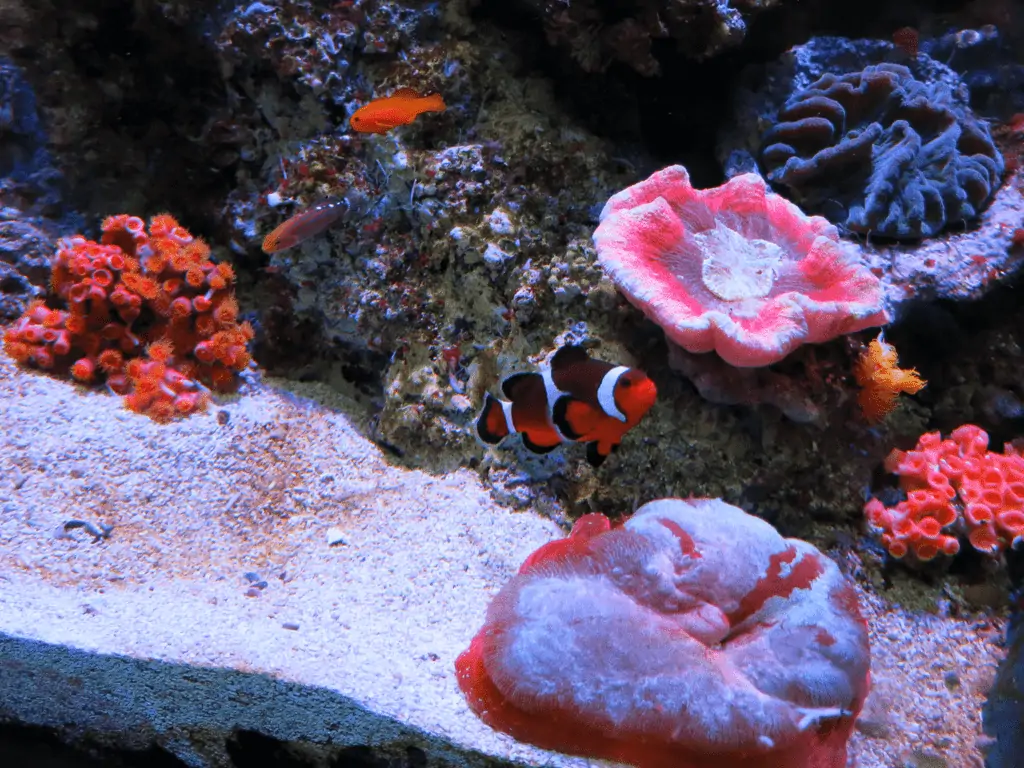
Every reef tank maintenance guide covers the visible tasks: scrub the glass, empty the skimmer cup, do a water change, check the equipment. Those are real and necessary. What most beginner content doesn’t cover in depth is the chemistry layer underneath — the parameters that don’t have a visible sign of trouble until the damage is already done.
For reef tanks, the three parameters that require the most active management are alkalinity, calcium, and magnesium. These are sometimes called the “Big Three” in reef keeping circles, and for good reason. Coral skeletons are made primarily of calcium carbonate, and the rate at which coral grows and maintains its structure depends on the availability of all three. Target ranges for a healthy reef system are roughly 8 to 12 dKH for alkalinity, 400 to 450 ppm for calcium, and 1,250 to 1,350 ppm for magnesium.
When any one of these drifts outside its range, coral growth slows, coloration changes, and tissue can begin to recede. The challenge is that these parameters are consumed continuously by coral and by natural chemical processes in the water. A tank with a healthy coral population can deplete alkalinity noticeably within a week. Without regular testing and active dosing — either through two-part solutions, kalkwasser, or a calcium reactor — parameters drift, and coral pays the price. Many beginners don’t realize their tank needs active dosing until they notice their SPS coral losing color, which means the drift has already been happening for some time.
Beyond the Big Three, phosphate and nitrate management are ongoing concerns. Both fuel nuisance algae growth and suppress coral health at elevated levels. Phosphate below 0.05 ppm and nitrate below 10 ppm are the targets for SPS-dominant reef systems. Achieving those numbers requires consistent filtration, regular water changes with RODI water, and attention to feeding — overfeeding is one of the most common causes of elevated nutrients in home reef systems.
This is the layer of reef tank maintenance that separates hobbyists who keep coral successfully over years from those who cycle through bleached frags and struggling fish. It’s not glamorous, but it’s what the work actually is.
Why Nassau County, NY Hobbyists Face Specific Maintenance Challenges
Local conditions matter more than most beginner guides acknowledge. Nassau County presents a few specific challenges that affect saltwater aquarium maintenance in ways that generic online advice doesn’t account for.
The water quality issue is the most significant. Long Island tap water is not suitable for saltwater aquarium use — not because it’s unsafe to drink, but because it contains chloramines, phosphates, nitrates, and silicates at levels that cause real problems in a reef system. Chloramines, in particular, are more persistent than chlorine and require more than a standard dechlorinator to address. Beginners who use tap water for their initial fill or ongoing water changes often find themselves battling algae blooms and parameter instability that they can’t trace back to the source because no one told them the water itself was the problem. RODI water isn’t optional in Nassau County — it’s the baseline.
Summer temperatures on Long Island create a second challenge. When ambient temperatures climb into the 90s during July and August, tanks in homes without consistent climate control can see water temperatures spike well above the 77 to 79°F range that marine fish and coral require. Temperature stress weakens immune systems in fish, accelerates bacterial growth, and can trigger coral bleaching. Hobbyists who don’t monitor temperature during summer months — or who leave for vacation without a plan for their tank — often return to a system that’s been stressed for weeks.
That vacation scenario is worth addressing directly, because it comes up constantly for Nassau County residents. With average commutes already eating into the day and travel being a regular part of life, having a maintenance service that operates seven days a week and can cover a tank during an owner’s absence isn’t a luxury — it’s practical insurance against coming home to a crashed system. We’ve been serving Nassau County and the surrounding area since 2003, and in that time we’ve seen the same preventable problems repeat themselves. The tap water issue. The summer temperature spike. The beginner who bought a starter kit, lost their first round of fish, and almost gave up before understanding what actually went wrong. These aren’t abstract risks — they’re the patterns we see in this specific market, and they’re the reason local expertise matters as much as general reef knowledge.
Getting Saltwater Aquarium Maintenance Right From the Start
The gap between a thriving reef tank and a failed one usually isn’t about effort or interest. It’s about having the right information at the right moment — before the starter kit is purchased, before the tank is filled with tap water, before the cycle is rushed. The decisions made in the first few weeks of a saltwater setup shape everything that follows.
If you’re in Nassau County, NY and you’re at the beginning of this process — or somewhere in the middle of it with questions you haven’t been able to answer — reach out to us. Island Fish & Reef has been doing this work since 2003, and our Bohemia storefront is the kind of place where you can get honest answers before you spend money in the wrong direction. We’re here to help you get it right.