
Summary:
You didn’t get into this hobby to spend your weekends troubleshooting water chemistry. You got into it because a well-kept reef tank is genuinely stunning — calming, alive, and unlike anything else you can put in a room.
But somewhere between the purchase and the present, maintenance became the whole job. The water tests, the algae you can’t get ahead of, the fish that died and you still don’t know why. If you’re a Nassau County homeowner commuting into the city five days a week, that guilt-inducing tank in your living room is the last thing you want to deal with when you get home.
This guide is an honest breakdown of what fish tank maintenance actually involves — and where the line is between a manageable hobby and a problem that needs professional help.
What Saltwater Tank Maintenance Actually Involves
Most people underestimate saltwater aquarium maintenance until they’re already in it. The short version: it’s not one task, it’s ten — and they all need to happen consistently, not just when you notice something looks off.
A proper saltwater maintenance routine covers water changes, glass and acrylic cleaning, protein skimmer cup emptying, filter media inspection, full parameter testing, top-off water management, equipment checks, and a visual health assessment of every fish and coral in the tank. Miss one of these regularly, and the others start to unravel. That’s not an exaggeration — it’s just how saltwater chemistry works.
The Real Weekly Workload of a Saltwater Aquarium
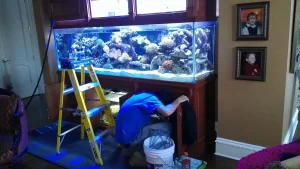
Here’s what a responsible weekly saltwater maintenance session actually looks like for a moderately stocked 75- to 100-gallon system.
You start with a water change — typically 10 to 25 percent of total volume every two weeks at minimum, using properly mixed, temperature-matched saltwater made from RO/DI-filtered water. For a 100-gallon system, that’s up to 25 gallons of water you need to prepare, mix to the right salinity, bring to the right temperature, and then physically swap out without stressing your livestock. It’s not difficult once you’ve done it a hundred times. Getting to a hundred times is the hard part.
Then comes the glass. Algae grows on every surface that gets light, and it grows fast. Interior walls need to be scraped or magnetically cleaned before the algae hardens into a mineral deposit that’s twice as hard to remove. The exterior gets wiped down too — salt creep is relentless, and it gets into everything if you let it go.
The protein skimmer cup needs to be emptied and rinsed. A skimmer that’s running with a full cup isn’t skimming — it’s just sitting there looking busy while organic waste accumulates in your water column. Filter media gets checked for saturation. Pumps and heaters get a visual inspection. Return pumps get checked for flow rate. Any drop in flow is an early warning sign of a blockage or impeller wear.
Then there’s parameter testing. A complete saltwater panel covers salinity, pH, ammonia, nitrite, nitrate, alkalinity, calcium, magnesium, phosphate, and temperature — ten variables that all interact with each other. If your alkalinity drifts, your coral growth slows and then stops. If your salinity spikes because evaporation outpaced your top-off system, fish start showing stress before you notice anything visually wrong. By the time you can see the problem, the damage is often already done.
Experienced hobbyists who’ve been running the same system for years can move through all of this in about 15 minutes a day. But that efficiency is earned over time — it doesn’t come with the tank. For most people in the first one to three years, maintenance is slower, less systematic, and far more reactive than proactive.
Why Nassau County Summers Create Unique Challenges for Reef Tanks
This is something that doesn’t come up in most online guides, because most online guides aren’t written for Long Island.
Nassau County summers regularly push into the mid-to-upper 80s, and inside a home without constant air conditioning, ambient temperatures can climb well above that. For a saltwater or reef system, that’s a serious problem. Elevated room temperatures cause your tank temperature to rise, which accelerates evaporation, which destabilizes salinity. Dissolved oxygen levels drop as water warms. Coral becomes stressed. Fish become lethargic and more susceptible to disease.
Managing a reef tank through a Nassau County summer without professional oversight is genuinely risky. The swings happen faster than most hobbyists expect, and by the time you notice the signs — bleaching coral, fish hanging near the surface, unusual lethargy — the tank is already in trouble.
The flip side is winter. When your heating system runs full blast and indoor humidity drops, evaporation rates increase again. Top-off water management becomes more demanding. Salinity creeps up if your automated top-off system isn’t calibrated correctly or if you’re doing it manually and missing days.
Both seasons create the same underlying problem: parameter instability caused by environmental conditions that are outside your control. A professional maintenance schedule accounts for seasonal shifts and adjusts accordingly. That kind of consistency is hard to maintain when you’re also managing a full-time job, a commute, and a household.
Nassau County’s geography adds one more layer worth mentioning. The county borders both the South Shore and the North Shore — the Atlantic and Long Island Sound. That proximity to the ocean is probably part of why so many residents are drawn to saltwater and reef systems in the first place. There’s something about living near the water that makes you want to bring a piece of it indoors. But the ocean takes care of itself. Your living room reef doesn’t.
Saltwater vs. Freshwater Tank Maintenance: What Changes When You Upgrade
If you’re currently running a freshwater tank and considering the jump to saltwater, this is the section you need to read carefully — not because saltwater is impossible, but because the maintenance gap between the two is larger than most people realize going in.
A well-kept freshwater tank requires monitoring three to five parameters, doing water changes every one to two weeks, and keeping the filter clean. It’s manageable for most hobbyists and forgiving enough that a missed week rarely causes a crisis. Saltwater is a fundamentally different system, and the margin for error shrinks considerably.

How Much Harder Is Saltwater Aquarium Maintenance Compared to Freshwater?
The honest answer is: meaningfully harder, and the difficulty compounds over time if you’re not systematic about it.
Freshwater maintenance is primarily about keeping ammonia and nitrite at zero, doing regular water changes, and keeping the filter running. Most freshwater fish are hardy enough to tolerate minor parameter swings without visible distress. The nitrogen cycle — the conversion of ammonia to nitrite to nitrate by beneficial bacteria — is the core chemistry concept, and once a freshwater tank is cycled and stable, it tends to stay that way with basic care.
Saltwater changes the equation on almost every front. You’re now managing ten or more parameters instead of three to five. Your water source matters — tap water contains chloramines and minerals that are tolerable in freshwater but actively harmful in saltwater systems, which is why RO/DI filtration is standard practice for saltwater maintenance rather than optional. Your livestock is more sensitive. Marine fish and coral have narrower tolerance ranges than their freshwater counterparts, and they show stress later and more suddenly — which means problems that would be a minor inconvenience in a freshwater tank can become a livestock emergency in a reef.
The equipment load increases too. Saltwater systems typically run protein skimmers, more powerful return pumps, additional powerheads for flow, and in reef setups, high-output lighting systems calibrated to specific spectrum and intensity requirements for coral growth. More equipment means more maintenance points, more potential failure modes, and more things to check on every visit.
There’s also the cost dimension. A freshwater community tank might have $50 to $150 in fish. A moderately stocked reef system can have hundreds to thousands of dollars in coral and fish — some individual coral frags cost more than a full freshwater setup. When something goes wrong in a reef tank, the financial stakes are real. That’s a reason to take the maintenance side of it seriously from the start.
When Does It Make Sense to Hire a Professional for Your Aquarium?
This is the question most hobbyists ask themselves eventually, and the honest answer is: earlier than you think.
The tipping point isn’t always a crisis. Sometimes it’s quieter than that — the slow realization that you’re spending more time managing problems than enjoying the tank, or that you’re anxious about going on vacation because you don’t trust what you’ll come home to, or that you’ve replaced the same fish three times and still don’t know why they keep dying. Those aren’t signs of failure. They’re signs that the system you’re running has outgrown the time and attention you’re able to give it.
For Nassau County residents who commute into Manhattan on the Long Island Rail Road or the LIE, the time math alone makes professional maintenance worth considering. A saltwater system that needs consistent weekly attention — not occasional attention, consistent attention — is a real commitment. If you’re leaving the house at 7am and getting back at 7pm, the tank isn’t getting the care it needs, and you know it.
Professional maintenance also makes sense at the moment of upgrade. If you’re moving from a freshwater setup to a saltwater or reef system, that transition is exactly when having an experienced team involved pays for itself. The first six months of a new saltwater tank — the cycling period, the initial parameter stability, the introduction of livestock — is where most failures happen. Starting with professional support means starting with someone who’s done this hundreds of times and knows what warning signs look like before they become emergencies.
We’ve been doing this since 2003. Our team has managed freshwater systems, planted tanks, saltwater fish-only setups, and full reef systems across all of Long Island — from Nassau County to the East End. We run four service vehicles seven days a week, which means we can respond to emergencies when they happen, not when it’s convenient. We maintain an on-site quarantine and holding facility, so any livestock we introduce to your tank has been health-screened before it ever touches your water. Every client gets a dedicated project manager — someone who knows your specific tank, its history, and what it needs.
We also installed the Bioscience Aquarium Lab at Farmingdale State College, which gives you a sense of the scale and complexity of systems we’re equipped to handle. Your reef tank in Oyster Bay or your office aquarium in Garden City is well within that range.
Finding the Right Aquarium Maintenance Service in Nassau County
The goal of a saltwater tank was never to spend your evenings troubleshooting chemistry. It was to have something beautiful, alive, and well-kept in your home or business — something that actually holds up over time.
The maintenance side of that is real, and it’s worth being honest about. Saltwater systems are demanding, Nassau County summers add pressure that most online guides don’t account for, and the cost of a crashed reef tank — in livestock, in time, in frustration — is almost always higher than the cost of professional care.
If you’re at the point where the tank feels like a burden rather than something you enjoy, or you’re about to make the jump to saltwater and want to start it right, Island Fish & Reef is worth a conversation. We’ve been taking care of Long Island tanks for over 20 years, and we’re not going anywhere.