Summary:
Why Reef Tank Automation Matters for High-End Homes
Reef tanks are living ecosystems that require stable conditions to thrive. Temperature swings, pH fluctuations, or a failed heater can wipe out thousands of dollars in livestock overnight. That’s the reality without automation.
Modern reef automation removes that risk entirely. Systems like Neptune’s Apex controller monitor your tank constantly, tracking temperature, pH, water level, and salinity in real time. If something goes wrong, the system responds immediately and sends you an alert. Your return pump shuts off before an overflow happens. Your heater cuts power if temperature spikes.
You’re not reacting to disasters anymore because the automation prevents them from happening in the first place. For homeowners in the Hamptons or North Shore building custom homes, this integration matters. Your aquarium becomes part of your smart home infrastructure, not a separate hobby requiring constant attention.
Neptune Apex Controller Setup for Custom Tanks
The Apex controller is the foundation of modern reef tank automation NY systems. Think of it as the brain that connects all your aquarium equipment into one coordinated system. It’s modular, which means you start with the basics and expand as your needs grow.
Out of the box, an Apex system monitors temperature and pH while giving you controllable power outlets for your equipment. You connect your heaters, pumps, and lights to the Energy Bar, and suddenly everything can be controlled and monitored from the Apex Fusion app on your phone. You’re at dinner in Manhattan and want to check your tank’s temperature? Pull out your phone. Need to turn off your return pump for maintenance? Do it from anywhere.
But the real power comes from what the Apex can prevent. Water level sensors detect rising sump levels and automatically shut off return pumps before water overflows onto your floor. Temperature probes catch heater failures and kill power before your tank turns into soup. Leak detectors placed around your stand send immediate alerts if water appears where it shouldn’t. These aren’t theoretical benefits—they’re the difference between a minor alert on your phone and coming home to a flooded room.
The system is expandable because your needs change over time. Start with basic monitoring. Add modules as you want more control. Need salinity monitoring? Add a conductivity probe. Want to track dissolved oxygen? Plug in a PM3 module. Every addition integrates seamlessly into the same Fusion app you’re already using.
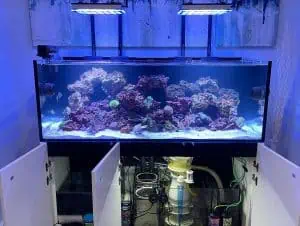
For custom aquarium design Nassau County installations, this modularity matters because your aquarium can be designed into the home’s infrastructure from the beginning. Sensors can be hidden. Wiring can be run through walls during construction. The result looks built-in, not bolted-on, because it actually is.
Installation during new construction or major renovation gives you options that retrofit situations don’t. Remote filtration rooms become practical when you’re planning plumbing routes before drywall goes up. Equipment can be located away from living spaces, keeping noise and heat where you don’t notice them. Working with us during the design phase ensures these integrations happen correctly. The aquarium becomes a design feature, not an equipment rack in your living room.
Automated Water Testing and Precision Dosing Systems
Reef tanks consume calcium, alkalinity, and magnesium as corals grow. Those levels drop daily. If they drop too far, coral health suffers. Traditionally, you test these parameters by hand several times per week and manually dose supplements to bring them back up. It works, but it’s time-consuming and leaves room for human error.
The Neptune Trident changes that completely. This automated testing system draws water from your sump, tests alkalinity, calcium, and magnesium multiple times per day, and logs the results in your Apex Fusion app. You see trends developing before they become problems. Alkalinity dropping faster than usual? You know it immediately, not three days later when you finally get around to testing.
The real breakthrough happens when you pair Trident with Neptune’s DOS dosing pumps. Now the system doesn’t just test—it responds. Alkalinity drops below your target? The DOS automatically doses more buffer. Calcium running high? Dosing gets dialed back. You set the parameters you want, and the system maintains them without your involvement.
This closed-loop automation is what serious reef keepers have wanted for years. Parameters stay stable because the system makes tiny adjustments throughout the day instead of you dumping in supplements once a week. Corals grow better under stable conditions. Colors improve. Polyp extension increases. You see the difference in how the tank looks.
For high-end fish tanks in residential installations, this automation means you’re not testing water on Saturday mornings. You’re not measuring out supplements and pouring them into your tank. You’re checking your phone occasionally to confirm everything’s running smoothly, and you’re actually enjoying the aquarium instead of maintaining it.
The Trident does require reagent refills roughly once per month depending on how often you test. That’s the trade-off for automation. But compared to manually testing three parameters several times per week, the time savings are substantial. You’re trading a few minutes of reagent replacement for hours of weekly testing.
Dosing precision matters more than most people realize. Alkalinity swings stress corals. Big doses cause temporary spikes that aren’t ideal even if the average stays correct. Automated dosing spreads supplementation across the entire day in tiny amounts, mimicking how a natural reef works. That stability translates directly into healthier livestock and better growth rates.
LED Lighting Technology for Modern Reef Tanks
Lighting has changed dramatically in the past decade. Older metal halide systems produced intense light but also intense heat, requiring chillers to keep water temperature stable. They consumed significant power and needed bulb replacements every 6-12 months. Not ideal for a high-end home installation.
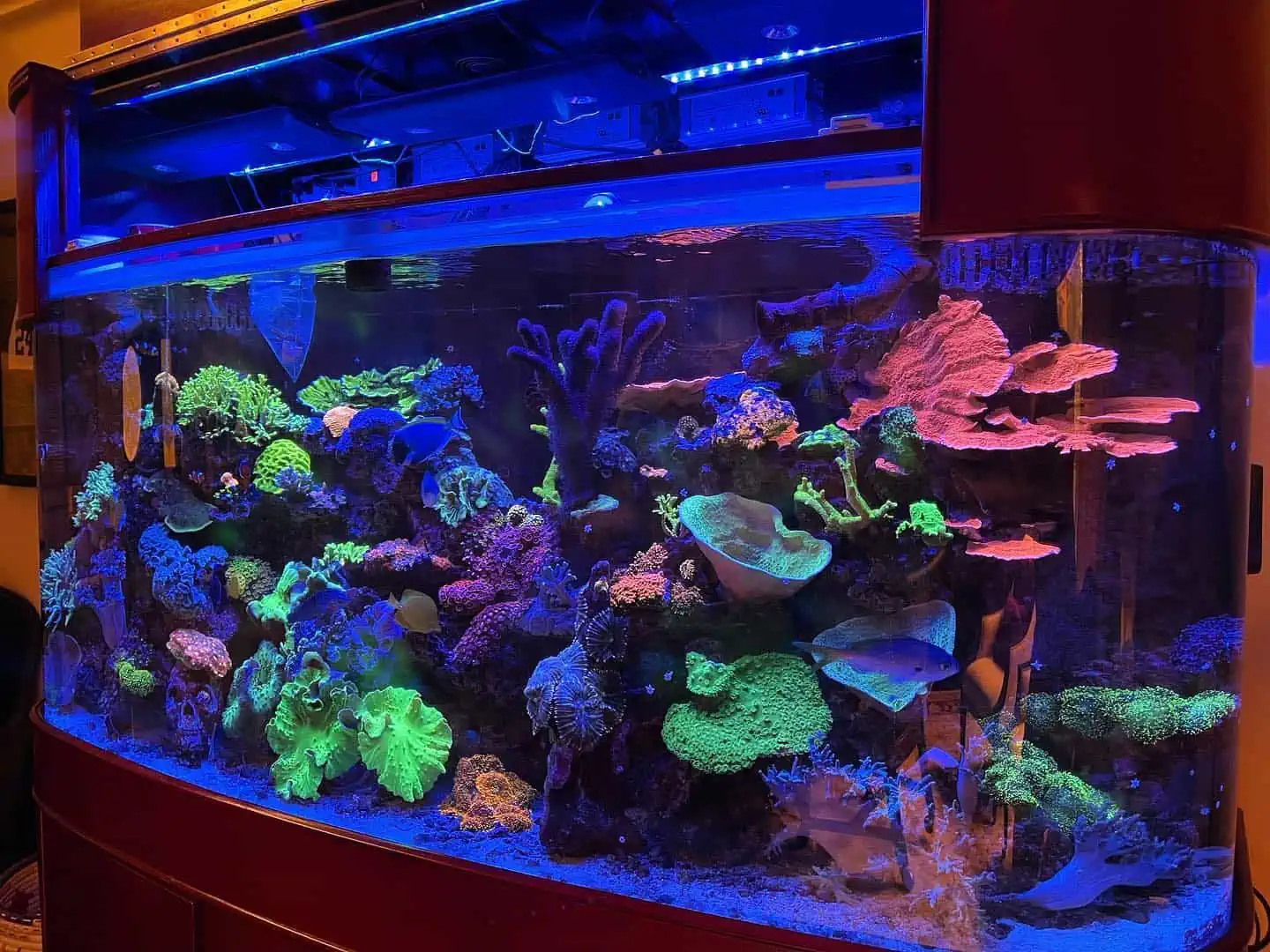
Modern LED reef lighting solves all of those problems. LEDs run cool, eliminating heat transfer into your water. They last years instead of months. Power consumption drops by more than half compared to equivalent metal halide setups. And the control options make older systems look primitive by comparison.
You can program sunrise and sunset ramps that gradually increase and decrease intensity. Lightning storm effects. Moonlight cycles. Cloud passing simulations. All of it controlled from your phone through apps that connect to the lights via WiFi or Bluetooth. For an aquarium in a living space, this programmability means the tank can match the mood you want at different times of day.
Choosing Quality LED Fixtures for Custom Installations
Not all LED fixtures perform equally. The market has plenty of cheap options that claim high output but use low-quality diodes that fail within two years or produce spectrums that don’t actually grow corals well. When you’re investing in a custom installation, fixture quality matters because you don’t want to be replacing lights in three years.
Proven brands like AI (AquaIllumination), EcoTech Radion, and Kessil have track records of actually growing corals and lasting. These aren’t the cheapest options, but they’re the ones that still work five years later. The diodes are high-quality. The heat management is engineered properly. The spectrum is designed based on actual coral biology, not just what looks pretty.
Spectrum matters because corals use specific wavelengths for photosynthesis. Blue and violet wavelengths penetrate water effectively and drive coral growth. White adds visual pop and brings out colors. UV enhances fluorescence. Quality fixtures balance these wavelengths to support coral health while creating the aesthetic you want.
Spread and intensity are the other critical factors. Spread refers to how evenly light distributes across your tank. Fixtures with poor spread create hot spots directly under the light and dim areas at the edges. You end up needing more fixtures to cover the same area, which increases cost. Well-designed optics spread light evenly, reducing the number of fixtures needed.
Intensity determines what you can grow and where. SPS corals need high intensity, typically 250-300 PAR or more. LPS corals thrive at moderate levels around 100-150 PAR. Softies can handle lower light. A good lighting plan places high-light corals near the top of your tank where intensity is strongest and lower-light specimens toward the bottom or sides where it’s dimmer.
For custom installations in Nassau County, NY and Suffolk County, NY, fixture mounting gets planned during design. Tank-mounted arms work for rimless tanks but can look cluttered. Hanging kits suspend lights from the ceiling, creating a clean look but requiring ceiling support capable of handling the weight. Built-in canopies hide fixtures entirely but reduce access for maintenance. Each approach has trade-offs that should be considered during the design phase, not after the tank is already installed.
Integration with automation systems adds another layer of capability. Fixtures that connect to your Apex controller can be programmed to respond to other tank conditions. Lights can dim automatically during feeding to reduce stress on fish. They can ramp down if temperature climbs too high. You can create virtual outlets that trigger lighting changes based on other equipment status. This level of integration only works when you plan for it from the beginning.
Programmable Lighting Schedules and Effects
One of the biggest advantages of modern LED systems is programmable control. You’re not just turning lights on and off anymore. You’re creating lighting schedules that mimic natural sunlight cycles and enhance how your aquarium looks throughout the day.
A typical reef lighting schedule ramps blue spectrum from zero to full intensity over 1-2 hours, simulating sunrise. Blues stay at full intensity for 8-10 hours, providing the light corals need for photosynthesis. White spectrum ramps up later and runs at lower intensity for only 4-6 hours in the middle of the day, adding visual pop without overdriving corals. Everything ramps down gradually in the evening, and a dim moonlight setting can run overnight.
This gradual ramping reduces stress on livestock compared to lights suddenly blasting on at full intensity. Fish and corals get time to wake up naturally. The tank looks better too, because you see the colors change as different spectrums ramp up and down throughout the day.
Advanced programming goes further. Cloud passing effects randomly dim lights for short periods, creating the dappled light patterns you see on natural reefs. Lightning storm modes create brief intense flashes. Some hobbyists program seasonal variations, gradually increasing photoperiod during summer months and decreasing it in winter to mimic natural changes.
For homes in Nassau County, NY and Suffolk County, NY where the aquarium is a design feature in living spaces, these effects add to the experience. Your tank doesn’t just sit there looking the same all day. It changes. Morning light looks different than afternoon light. Evening brings a different mood entirely. The aquarium becomes dynamic, not static.
The programming happens through apps on your phone or tablet. Manufacturers provide preset schedules that work well for most tanks, but you can customize every detail if you want. Adjust intensity for individual color channels. Change ramp times. Create multiple schedules for different days of the week. Save and share programs with other users. The level of control is extensive, but it doesn’t have to be complicated if you just want to use the presets.
Integration with smart home systems is becoming more common. Some LED fixtures can connect to systems like Control4 or Crestron, allowing your aquarium lighting to be controlled alongside your home’s other lighting. Scenes can be created that adjust both room and tank lighting together. For high-end homes where smart home integration is already planned, adding the aquarium to that system makes sense. We work with these integrations regularly in Hamptons and North Shore custom homes, ensuring your smart aquarium setup functions seamlessly with your other systems.
Planning Your Automated Reef Tank in Nassau or Suffolk County
Modern reef automation isn’t about adding complexity. It’s about removing the parts of reef keeping that used to require constant attention and replacing them with systems that handle it for you. You get the visual impact of a custom reef tank without the time investment that traditionally came with it.
The key is integration during the design and build phase. When automation is planned from the beginning, equipment can be located properly, wiring can be hidden, and the result looks like it belongs in your home instead of being added as an afterthought. For homeowners building or renovating in areas like the Hamptons or North Shore, this is the time to make those decisions.
If you’re considering a custom aquarium for your home and want it done right from the start, we’ve been integrating these systems into Long Island homes for over two decades. The technology works. The question is whether you want to experience it.