Summary:
If you’ve tried to find out what professional saltwater aquarium maintenance costs in Nassau County, NY, you’ve probably run into the same thing: nothing. No numbers, no ranges, just “contact us for a quote.” That’s frustrating when you’re trying to figure out whether this is even in your budget before committing to a conversation.
This page gives you the actual numbers — broken down by tank size, system complexity, and how often service runs. We’ll also cover what a proper maintenance visit includes, what happens when service gets skipped, and what makes pricing vary from one tank to the next. By the end, you’ll have a clear picture of what you’re looking at.
Saltwater Tank Maintenance Cost: What Nassau County Owners Actually Pay in 2026
Professional saltwater aquarium maintenance in Nassau County, NY typically runs somewhere between $100 and $800 per month, depending on the size of your tank, the type of system you’re running, and how often a technician visits. That’s a wide range — and it’s wide for a reason. A 30-gallon fish-only tank in a home office is a very different job than a 200-gallon SPS reef in a Great Neck living room.
Most residential clients in Nassau County with mid-size saltwater systems fall somewhere in the $200 to $500 per month range for regular weekly or bi-weekly service. Commercial setups — the kind you’d see in a medical practice along Northern Boulevard or a restaurant near Sunrise Highway — often run $400 to $800 per month, depending on tank volume and complexity.
What drives cost up is complexity, not just size. Reef tanks, especially those with SPS corals, require tighter water chemistry management and more frequent attention than a fish-only system.
Cost to Maintain a Saltwater Aquarium: How Tank Type Changes the Math
The single biggest factor in what you’ll pay isn’t the size of your tank — it’s what’s living in it. A fish-only with live rock (FOWLR) system is forgiving. Parameters can drift a bit without immediate consequences, and a bi-weekly or even monthly service schedule can work for smaller setups. A 150-gallon FOWLR tank might run $300 to $400 per month with regular visits.
A reef tank is a different story. Corals — especially SPS varieties like Acropora — have a narrow tolerance window for alkalinity, calcium, and magnesium. If those numbers drift during a missed service cycle, you’re not just looking at stressed fish. You’re looking at bleached coral that took years to grow and hundreds or thousands of dollars to replace. That’s why a 150-gallon SPS reef typically costs $600 to $800 per month to maintain professionally. The chemistry work alone justifies the difference.
Service frequency matters too. Weekly service costs more than bi-weekly, which costs more than monthly — but the gap isn’t always as large as people expect, because a lot of the cost is in the technician’s time and travel, not just the consumables used during the visit. For heavily stocked tanks or active reefs, monthly service is often the minimum, not the standard. Trying to stretch a reef tank to once-a-month visits is one of the more common ways hobbyists end up in trouble.
There’s also a misconception worth addressing: smaller tanks aren’t cheaper or easier to maintain in saltwater. A 30-gallon reef is actually harder to stabilize than a 150-gallon one, because there’s less water volume to buffer parameter swings. The service cost per gallon tends to be higher on smaller systems, not lower.
One more thing that affects cost — and this one surprises people — is whether the service provider is absorbing consumable costs or billing them separately. Salt mix, RO/DI water, filter media, carbon, GFO: these aren’t free. Some providers include them in a flat monthly rate. Others bill them as line items. It’s worth asking before you sign anything.
What's Actually Included in a Professional Saltwater Aquarium Maintenance Visit
This is the question most people don’t think to ask until they’re already paying for service — and then wondering what they’re actually getting. A proper professional maintenance visit for a saltwater system covers more ground than most hobbyists realize when they’re doing it themselves.
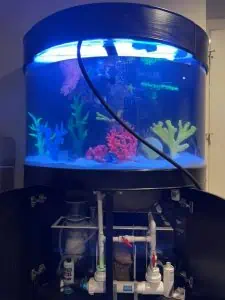
At minimum, every visit should include a full water parameter test: salinity, pH, ammonia, nitrite, and nitrate at baseline, with alkalinity, calcium, and magnesium added for reef systems. A partial water change — typically 10 to 20 percent of the tank volume — removes accumulated waste and replenishes trace elements. The glass or acrylic gets cleaned inside and out, algae gets removed from rocks and surfaces, and the protein skimmer gets cleaned and checked. Filter media gets inspected and replaced as needed. Every piece of equipment — pumps, heaters, return lines, lights — gets looked at. And every fish and coral in the tank gets a health assessment.
On our end, a visit also includes salt creep removal, sump and refugium cleaning when applicable, and dosing system calibration for tanks that run automated two-part or kalkwasser dosing. We document what we find and what we did, so there’s a record of your tank’s health over time — not just a technician showing up and disappearing.
What separates a good maintenance provider from a mediocre one isn’t the checklist. It’s whether they actually follow it every time, and whether the person doing it knows what they’re looking at. A technician who’s been maintaining reef tanks for years will notice a fish behaving differently before it becomes a problem. Someone who learned the routine last month won’t.
This is one of the reasons we assign the same technician to your tank consistently. The reviews we hear most often mention specific names — Chris, Todd, Downs — because those relationships matter. When the same person shows up week after week, they know your system. They know what’s normal for your tank. That institutional knowledge is part of what you’re paying for.
Saltwater Fish Tank Maintenance Cost vs. Doing It Yourself in Nassau County, NY
The DIY math is worth running before you assume professional service is the more expensive option. A serious hobbyist maintaining their own 100 to 180-gallon saltwater system can expect to spend $125 to $150 per month minimum in consumables alone — salt mix, filter media, test reagents, RO/DI filters, food — before accounting for electricity, equipment replacement, or their own time.
Add four to eight hours of labor per month, and the true cost of DIY starts to look a lot closer to professional service than most people expect. The difference is that a professional service removes the time burden entirely and carries the risk of a parameter crash — not you.
What Skipping Saltwater Aquarium Maintenance Actually Costs You
This is the part of the cost conversation that rarely comes up — but it should. Professional maintenance isn’t just a convenience. For a saltwater or reef system, it’s closer to insurance.
When a complex saltwater tank goes without proper service for an extended period, the recovery costs are significant. Algae blooms that develop over a few missed cycles can take 40 to 60 hours of restoration labor to fully clear. Livestock losses from parameter drift — the kind that happens slowly and then suddenly — typically run 20 to 60 percent of the tank’s inhabitants. Replacing those fish and corals costs $500 to $2,500 depending on what you had. And that’s before you factor in any equipment that failed quietly while no one was checking it.
Nassau County’s municipal water supply, drawn from the Long Island aquifer system, has a mineral content that affects aquarium chemistry in ways that aren’t always obvious to hobbyists. Without regular RO/DI water management and parameter testing, those minerals accumulate. It’s a real local factor that we account for on every visit — and one that DIY hobbyists sometimes don’t catch until the damage is done.
The September window is worth mentioning here, because it’s the most common time we hear from Nassau County hobbyists who need help. Residents who spent July and August at beach houses or traveling come back to tanks that have been running on autopilot for weeks. Algae has taken hold, parameters have drifted, and in some cases, livestock has been lost. Getting professional eyes on a neglected tank in September — before the problems compound — is almost always cheaper than waiting until things spiral further.
Why Nassau County, NY Saltwater Aquarium Maintenance Rates Run Higher Than National Averages
If you’ve read national guides quoting $100 to $150 per month for saltwater maintenance and wondered why Nassau County quotes come in higher, the answer is straightforward. Operating costs in Nassau County, NY are meaningfully above the national average — fuel, insurance, vehicle operation, and labor all cost more here than they do in most other markets. A professional service running four dedicated vehicles seven days a week across Nassau and Suffolk Counties is carrying overhead that a solo operator in a lower-cost market simply isn’t.
That overhead translates into something real for the client: reliability. A fleet of four service vehicles means that when something goes wrong with your tank on a Sunday evening, there’s actually someone available to respond. A one-person operation fitting maintenance visits between other jobs can’t make that promise.
Nassau County is also a market where the stakes are higher than average. With a median home value around $684,700 and a dense population of professional households — many commuting into Manhattan via the Long Island Rail Road — the aquariums in these homes tend to be significant installations. A 200-gallon reef in a Gold Coast home in Great Neck or Oyster Bay represents a real financial and aesthetic investment. The cost of professional maintenance, in that context, is a small fraction of what it would cost to rebuild after a failure.
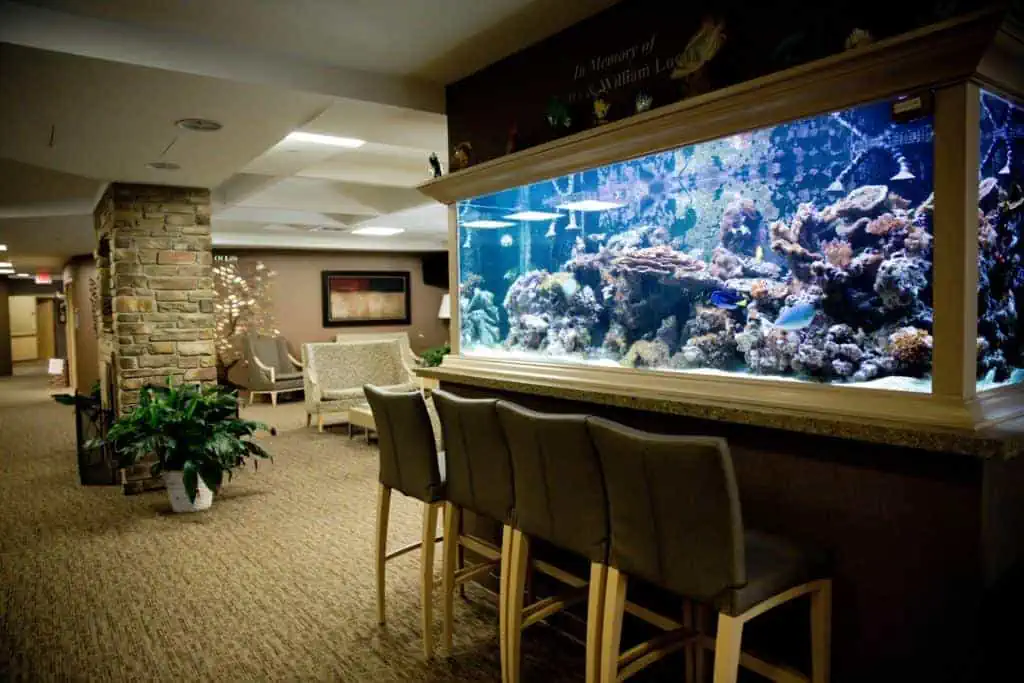
Commercial clients along Nassau County’s major corridors — medical practices, dental offices, restaurants, law firms — operate under different constraints than residential owners. They can’t have a tank look neglected in front of patients or clients. They need service that shows up on schedule, documents what was done, and handles problems without drama. That professional standard is what we bring to every account, residential or commercial.
We’ve been working in this market since 2003. The Farmingdale State College Bioscience Aquarium Lab installation is one of the projects we’re most proud of, because it reflects the kind of technical work we do when the margin for error is zero. That same standard applies to the reef tank in your living room.
Getting a Real Quote for Saltwater Aquarium Maintenance in Nassau County, NY
The short version: professional saltwater aquarium maintenance in Nassau County, NY runs $100 to $800 per month depending on tank size, system type, and service frequency. Reef systems cost more than fish-only setups. Weekly service costs more than monthly. And the true cost of DIY — in time, consumables, and the risk of a crash — is closer to professional service than most people assume.
What you’re really paying for is consistency, expertise, and the peace of mind that comes from knowing your system is being watched by someone who actually knows what they’re looking at. For a saltwater tank, that’s not a luxury. It’s how tanks survive long term.
If you’re ready to get a straightforward answer about what service would look like for your specific setup, Island Fish & Reef has been doing this work in Nassau County, NY since 2003. Reach out and we’ll give you a clear picture — no runaround, no pressure.