Summary:
If you’ve been searching saltwater vs. freshwater, you’ve probably read the same answer a dozen times: freshwater is easy, saltwater is hard, pick one. It isn’t wrong, but it leaves out the part that matters most, which is who is doing the work. Maybe you’re picturing a reef in a Long Beach living room, or a quiet planted tank in a Farmingdale office lobby. Either way, the real question is how much of the daily upkeep you want on your plate. Here’s how we walk Nassau County and Suffolk County customers through the decision, starting with what separates the two.
What Separates Saltwater And Freshwater Aquariums On Long Island
The differences are real. A marine tank generally needs more equipment than a freshwater one, along with closer water monitoring. You’re mixing salt, running specialized lighting, and often using RO/DI water, especially once corals come into the picture. Freshwater setups are simpler on every one of those fronts.
But gear and chemistry are only half of it. The other half involves considering if you are the one handling them. National data from the American Pet Products Association points to something interesting: 85% of saltwater owners bought fish in the past year, compared with 72% of freshwater owners, and 77% of saltwater owners plan to buy again within the next year. People who start a saltwater tank tend to stay in it. The ones who stay are usually the ones who had good help at the start.
Is A Saltwater Tank Too Hard For A Beginner In Nassau County Or Suffolk County?
Not when it’s set up properly. Saltwater tanks earn their reputation from the rushed ones: fish added before the tank has cycled, testing skipped, livestock that arrived stressed and never recovered. Get those pieces right and a first-timer can run a marine tank without a chemistry degree.
The benchmark we use is simple. Before a single fish goes in, a liquid test kit, not paper strips, should show ammonia and nitrite at zero. That one habit prevents more early losses than any piece of expensive equipment.
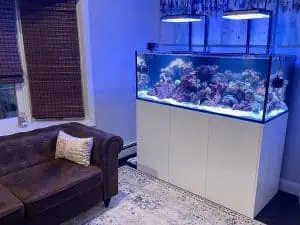
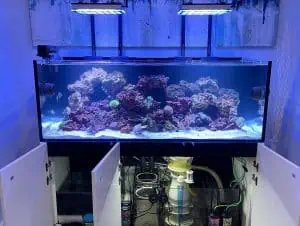
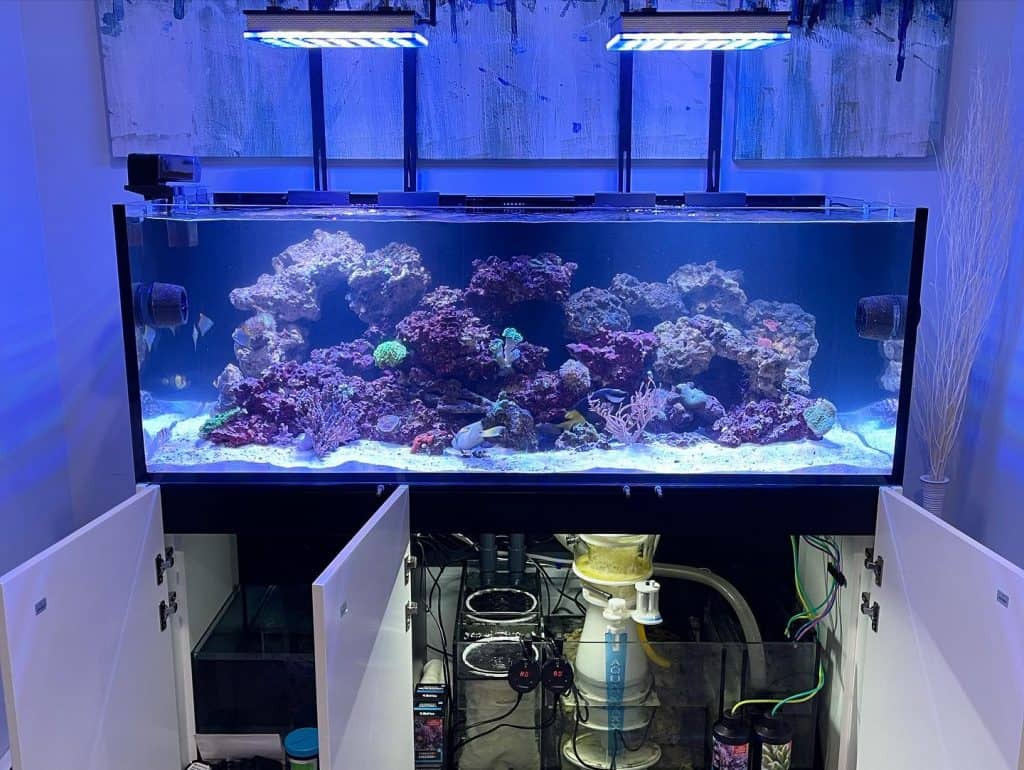
Then there’s the hardware. Saltwater systems often involve a sump, plumbing, a skimmer, and lighting that has to be dialed in. One of our clients had never worked with a sump and didn’t know where to begin. Another had built a DIY skimmer and called us for a Saturday visit to troubleshoot it, which turned into a biweekly maintenance relationship. Both ended up with healthy, working systems.
This is where the question changes. We design and install the tank, and if you’d like to learn, we’ll train you on the light maintenance while we’re there. If you’d rather not, weekly or biweekly visits keep everything where it should be. Our founder, Corey, earned his MBA while working full-time for the Long Island Rail Road, so we understand that most households in Nassau County and Suffolk County aren’t short on interest in a reef. They’re short on hours. A tank that fits around a commuter’s week is a tank that survives.
What About A Planted Freshwater Tank Or Nano Reef For Your Long Island Home?
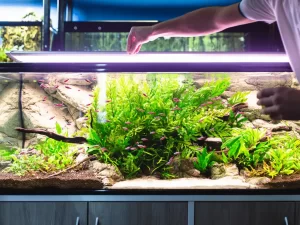
Sometimes the answer sits between the two ends. A planted freshwater tank, with real plants, driftwood, and a well-chosen group of fish, can look every bit as designed as a reef. It’s calmer and earthier, and it’s often easier to keep steady. Bettas, catfish, and small schooling fish show up in tanks that people mistake for something far more elaborate.
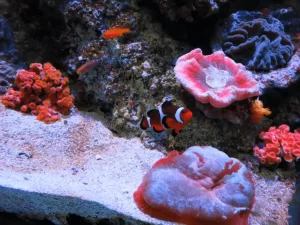
On the saltwater side, a nano reef gives you coral and color in a smaller footprint. It still needs mixed saltwater, lighting, and regular checks, but the scale is more manageable. For someone who loves the look of a reef and is not sure they’re ready for a big system, it’s a sensible way in.
One thing worth knowing: freshwater isn’t automatically the cheaper road. A large, heavily planted or heavily stocked freshwater tank can end up costing about what a saltwater tank does. Cost follows size, equipment, and livestock far more than it follows the type of water.
Where the tank lives matters too. If you’re in Atlantic Beach or Island Park, a reef can feel like a natural fit for life near the water. In a medical office or business lobby, which we install in as well as homes, a steady, good-looking planted tank may serve better than a coral showpiece that needs close attention.
So ask yourself what you want to see when you walk past it every day. Calm and green, or bright and busy? That answer usually points you to the right tank faster than any spec sheet.
Where Your Saltwater Fish Come From Matters On Long Island
Most comparisons stop at the tank. They rarely talk about the animals, and that’s a gap, because livestock is where saltwater gets expensive and where a bad start hurts most.
Saltwater fish are generally harder to source and cost more than freshwater fish, and they’re more sensitive to the stress of shipping. A fish that arrives worn out and goes straight into a sales tank is already behind before you ever take it home. At big-box stores, fish often go from the delivery truck to the sales tank the same day.
That’s a different process from ours. Every fish and coral we handle goes through our on-site quarantine and holding facility, and we’ve done it that way since 2003. Fish are monitored for about two weeks, and we make sure they’re healthy and eating before they go to a client’s tank.

Why Quarantine Matters When Buying Saltwater Fish In Nassau County And Suffolk County
Quarantine is a holding period where new animals live apart from any display tank. It gives problems time to show up somewhere they can’t spread, and it gives fish time to recover from the trip and start eating normally. A fish that won’t eat after a week is telling you something, and you’d rather learn that in a holding system than in your living room.
Whatever shop you use, there are things you can check yourself. Look for clear eyes, intact fins, and full bodies. The fish should swim upright and react when someone walks up to the glass. Red streaks near the gills or a sunken belly are warning signs. Cloudy display water is another one. And ask the staff directly how they quarantine and concerning how they dip corals to limit pests. A good answer comes quickly and in detail.
It also helps to know that “no returns, no exceptions” is the norm at most fish stores. Serious hobbyists on forums say so often. Since you usually can’t count on a refund, you want the health work done before the fish ever reaches you.
If you want a second opinion on any shop, Long Island has an active hobby community. The Long Island Aquarium Hobbyists group on Facebook and the Nassau County Aquarium Society are both worth a look. Ask people where their fish came from and how long they’ve lasted. Honest hobbyists will tell you, and that’s the kind of local information that’s worth more than any review score.
Can I Hire Someone On Long Island To Set Up And Maintain My Aquarium?
Yes, and for many of our clients it’s the reason a saltwater tank works at all. We started out as an aquarium shop in Bohemia and have since become a full-service design, installation, stocking, and maintenance company. We work with freshwater, planted, saltwater, and reef systems, from modest goldfish tanks to elaborate coral reefs. If you’re looking for an aquarium store with a showroom floor, call us first so we can tell you how we work before you make the trip.
Each new client gets a project manager who covers the details that trip people up: tank size, filtration, cabinetry, glass, which species can live together, and how often the tank needs attention. After installation, weekly or biweekly visits keep the water, equipment, and animals in check. If you’re traveling, we can schedule visits around your existing feeding routine. If you’re moving, we relocate the whole system at once, keep the water heated, and move the fish in insulated containers so the trip doesn’t turn into a crash.
We’re fully licensed and insured, and we serve homes and businesses from Manhattan to Montauk. That includes Bohemia, Islandia, Ronkonkoma, Bay Shore, Farmingdale, Long Beach, Island Park, Franklin Square, and Atlantic Beach, along with the towns in between. The first conversation is a free consultation with no obligation. You can tell us about your space, your schedule, and how much of the upkeep you want to handle, and we’ll give you an honest read on which tank makes sense.
Choosing Between Saltwater And Freshwater On Long Island
Freshwater is simpler and saltwater asks for more, but that’s only part of the picture. What really matters is how the tank is set up, where the fish come from, and who handles the upkeep. With a proper cycle, a quarantine period, and regular professional visits, saltwater is well within reach for a busy household in Nassau County or Suffolk County. And if a planted freshwater tank or a nano reef suits your space better, that’s a perfectly good place to land.
Contact Island Fish & Reef today at 631-467-3474 to schedule your complimentary consultation and find out which aquarium setup is the right fit for your home or office.