Summary:
Search “aquarium store” anywhere in Suffolk or Nassau County, NY and you’ll get plenty of options, plus a tourist attraction in Riverhead that has nothing to do with buying a fish. If you keep coral or saltwater fish, distance matters less than a different question: who do you trust with animals that cost real money and can take down a whole reef if one arrives sick? We’ve been working across Long Island since 2003, out of Bohemia, and we’ll walk you through what to ask any shop, including us, before you buy. First, what an aquarium store needs to be.
What Should You Expect From An Aquarium Store On Long Island?
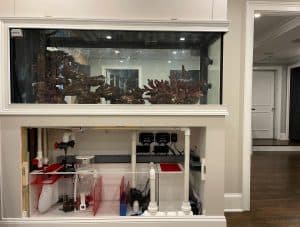
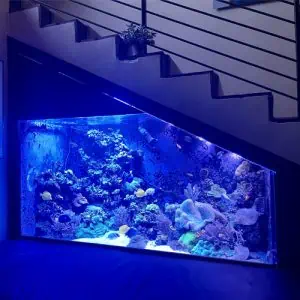
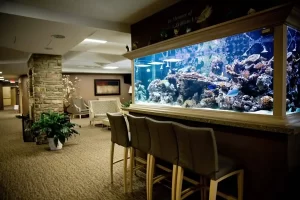
Most people picture a storefront with rows of lit tanks. That’s one version, and Long Island has some good ones. We began as a retail store, and in late 2013 we changed our name to Island Fish & Reef and put our focus on designing, installing, stocking and maintaining tanks for homes and businesses across Suffolk and Nassau County, NY. We’re not a walk-in showroom, and we won’t pretend to be.
What we are is the aquarium shop team that sources the fish and coral, holds them in our own facility, puts them in your system, and comes back to keep them alive. For a saltwater keeper, that’s usually the part that matters. Buying the animal takes one afternoon. Keeping it healthy is everything that comes after.
How Can You Tell If A Long Island Fish Store Really Quarantines Its Livestock?
Anyone can say “everything is quarantined.” Saying it costs nothing, and quarantine itself is expensive, which is why it tends to show up in the price. So ask for details, and pay attention to how the answer sounds.
Start with how long. Reef-supply guides commonly recommend 30 to 90 days in a separate system for fish. That’s a lot to ask of a business that has to move stock, so a straight answer matters more than a perfect number. Ask if the animals sit in their own system, away from the sales tanks, or go from the shipping box straight to the display. Ask how corals are dipped and if anyone checks on them daily. A person who does this work can answer in a sentence or two. Someone who changes the subject has told you something.
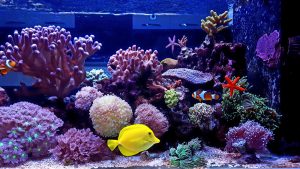
Then look at what you can see. Fish should have clear eyes, steady breathing and no spots or lesions. Tanks shouldn’t have dead stock sitting in the corner. Staff should be able to tell you a fish’s adult size and if it will leave your corals alone, instead of steering you toward whatever’s on sale. Long Island reef forums keep circling the same complaint: staff who sell people things they didn’t need. A good shop will talk you out of a purchase now and then.
Last, be realistic about what quarantine can do. It improves your odds. It doesn’t make a fish risk-free, and even the best-run shop will tell you to acclimate carefully and dip corals again at home. If a store promises zero risk, treat that as a red flag.
What Happens To Our Fish And Coral Before They Reach Your Tank?
Every fish and coral we bring in goes through our on-site quarantine and holding facility in Bohemia before it’s offered to a client. Animals are monitored while they’re there, and nothing goes straight from a shipper into your display. If you want to know exactly how long that hold lasts, ask us on a call and you’ll get the specifics from the person who handles it, not a round number in a blog post. We also won’t tell you our process replaces what you do at home. Acclimate slowly, dip corals again, and keep a close eye on the tank for the first couple of weeks.
Quarantine is only half of it. Livestock has to suit the system it’s going into. One client needed particular fish, corals and equipment to work with an existing setup, and we tracked them down. That kind of matching is where plenty of reef problems begin: the wrong fish beside the wrong coral, or a species that outgrows its tank in a year. Each project gets one project manager who handles tank size, filtration, cabinetry, glass and species compatibility, so you aren’t repeating yourself to five different people.
We install what you’ve chosen, whatever the brand. Our team works seven days a week, 7am to 7pm, with emergency service on top of that, which matters when a heater sticks at six on a Sunday morning in Lynbrook or Valley Stream. Clients across Suffolk and Nassau County, NY describe our technicians as punctual, polite and careful, which counts when someone is working a few feet from your living room or your office reception desk.
Local Aquarium Shop, Chain Store Or Online Coral Vendor: What Fits Suffolk And Nassau County Keepers?
Each option wins somewhere. Chain stores are convenient, but from what we’ve seen, fish tend to move from central distribution straight to display, and staff marine knowledge varies from store to store. That’s our read from the work we do, not an independent study. Online vendors offer variety, especially rare corals, and they make the most sense where shipping weather is mild. Local specialty shops, and we’re glad Nassau and Suffolk County, NY have several, give you something the other two can’t: a person to ask when something goes wrong.
Your tank size changes the math. APPA’s 2025 report found that 44% of saltwater owners now run tanks between 56 and 125 gallons, up 10 points from 2023, and another 34% run 126 gallons or more, up 17 points. The bigger the system, the more a single bad purchase costs you.
Is It Safe To Order Corals And Saltwater Fish Online In A Long Island Winter?
Long Island winters aren’t kind to a box of live animals. Anything shipped in January spends time on a truck, a porch or in a depot, and every hour in the cold is a risk the seller can’t fully control. We can’t give you a failure rate, and we won’t invent one. We can tell you what hobbyists report. One reef forum poster described ordering 33 fish online and finding 13 dead or dying on arrival, then losing 13 more in the first week, with ich introduced to the system. That was about $1,000 of livestock. It’s one story, not a statistic, but it explains why so many keepers get nervous about mail order.
Ich is the thing to understand. Once it’s in your display, treatment usually means setting up a hospital tank, medicating, and managing the fish for weeks, and sometimes it means pulling every fish out of the display. Quarantined animals cost more per fish. They usually cost less than an outbreak.
None of this takes online buying off the table. If you want a rare coral nobody in Suffolk or Nassau County, NY carries, ordering it can be the right call. Pick a mild stretch of weather, ask the seller about quarantine and dips, and put the new arrival in its own tank before it ever touches your reef. Treat it the way you’d want us to treat anything we bring in.
Quick Answers For Nassau And Suffolk County Keepers: Vacations, Moves And Neglected Tanks
Can someone feed and check my tank while I’m away? Yes. We schedule feeding and monitoring visits while you travel, which suits a part of the Island where plenty of people commute into the city all week and head out of town on weekends and holidays.
Do you work in Nassau, or only Suffolk? Both. We’re based in Bohemia and serve Nassau towns like Long Beach, Lynbrook, Valley Stream, Farmingdale and the Roosevelt Field area, as well as Suffolk spots like Bay Shore, Islandia, Hauppauge, Medford and Greenport. Our service area runs Manhattan to Montauk.
I’m moving, or I bought a house with a tank still in it. Now what? We handle relocations by moving the whole system in one go, keeping the water heated and holding fish in heated, oxygenated containers. We’ve also removed tanks left behind by previous owners, and clients have told us the teardown was quick and clean.
My tank went downhill while I was busy. Is it a lost cause? Usually not. We rehabilitate neglected systems, so a lapse doesn’t have to mean starting over.
Do you handle office tanks? Yes, residential and commercial. One office client had us move a 120-gallon reef tank and has used our weekly service ever since.
Are you licensed and insured? We are, fully.
Looking For An Aquarium Store In Suffolk Or Nassau County, NY? Start With A Conversation
The short version: ask every shop how it quarantines, what it does with corals, and who helps once the sale is over. Weigh local, chain and online sourcing against the size of your tank and the time of year. Remember that no quarantine makes an animal risk-free, so acclimate and dip at home no matter where you buy.
We built Island Fish & Reef around that last part, the stretch after the purchase. We source and hold the livestock, install the system, and keep it running through travel, moves and busy stretches, all across Suffolk and Nassau County, NY. Contact Island Fish and Reef today to start planning your custom saltwater setup.